
Tag: hotel jobs for foreigners

  • Complete Guide to Get Hospitality Jobs in United States in Hotels, Restaurants, and Resorts

    Complete Guide to Get Hospitality Jobs in United States in Hotels, Restaurants, and Resorts

    The hospitality industry is one of the largest service industries in the United States and provides employment opportunities in hotels, restaurants, resorts, event venues, and other travel-related businesses. Hospitality jobs are available for both experienced professionals and people looking for entry-level work.

    Common positions include hotel front-desk agents, housekeepers, chefs, cooks, servers, bartenders, resort staff, maintenance workers, guest-service representatives, and hospitality managers.

    If you are interested in building a career in the U.S. hospitality industry, understanding the available jobs, requirements, salaries, application process, and work authorization rules can help you prepare effectively.

    1. Types of Hospitality Jobs in the United States

    Hospitality is a broad industry with many different career options.

    Hotel Jobs

    Hotels regularly hire workers for departments such as:

    • Front desk and guest services
    • Housekeeping
    • Concierge services
    • Food and beverage
    • Maintenance
    • Reservations
    • Sales and marketing
    • Hotel management

    Entry-level positions such as room attendant, housekeeping worker, and hotel helper may require limited previous experience, while management positions generally require hospitality experience and stronger leadership skills.

    Restaurant Jobs

    Restaurants offer opportunities for people with culinary and customer-service skills.

    Common positions include:

    • Chef
    • Sous chef
    • Line cook
    • Prep cook
    • Server
    • Host or hostess
    • Food runner
    • Dishwasher
    • Restaurant manager

    Restaurant experience can also provide a pathway toward supervisory and management positions.

    Resort Jobs

    Resorts often employ workers across several departments, including:

    • Guest services
    • Housekeeping
    • Restaurants
    • Bars
    • Recreation
    • Spa services
    • Maintenance
    • Events
    • Front office

    Resort employment can be particularly relevant in destinations that attract tourists throughout the year or during specific seasons.

    2. Check the Basic Job Requirements

    Requirements depend on the position and employer.

    Entry-level hospitality jobs may focus on:

    • Reliability
    • Communication
    • Customer service
    • Teamwork
    • Flexibility
    • Ability to follow instructions
    • Professional behavior

    For specialized jobs, employers may require previous experience, education, or certifications.

    For example, chefs may need substantial kitchen experience, while maintenance workers may need technical skills. Hotel managers may have hospitality-management education or several years of industry experience.

    3. Improve Your English and Customer-Service Skills

    Strong communication skills are valuable in hospitality because employees frequently interact with guests and coworkers.

    Workers should be able to:

    • Welcome customers
    • Answer questions
    • Explain services
    • Take reservations or orders
    • Handle basic complaints
    • Communicate with team members
    • Follow workplace instructions

    If English is not your first language, practicing common hospitality conversations can improve your confidence during interviews and at work.

    Additional language skills can also be useful in hotels and resorts that serve international visitors.

    4. Prepare a Professional Resume

    A good resume is important when applying for hospitality jobs.

    Include:

    • Name and contact information
    • Professional summary
    • Work experience
    • Education
    • Certifications
    • Relevant skills
    • Languages

    Customize your resume for the position.

    For a hotel front-desk job, emphasize customer service, computer skills, reservations, and communication.

    For housekeeping, highlight cleaning experience, attention to detail, time management, and reliability.

    For restaurant jobs, mention food preparation, customer service, POS systems, food safety, and previous restaurant experience.

    For management positions, emphasize leadership, staff supervision, budgets, operations, sales, and customer satisfaction.

    5. Get Relevant Training

    Training can improve your chances of getting hired and progressing in the industry.

    Useful areas include:

    • Hospitality management
    • Customer service
    • Food safety
    • Food handling
    • Workplace safety
    • Computer skills
    • Hotel reservation systems
    • Culinary skills
    • Leadership

    Not every hospitality job requires formal education. Many entry-level workers receive training directly from their employer.

    However, specialized qualifications can be valuable for professional positions and long-term career development.

    6. Search for Hospitality Jobs Online

    Use specific job titles when searching for employment.

    Examples include:

    • Hotel Front Desk Agent
    • Guest Service Agent
    • Hotel Housekeeper
    • Room Attendant
    • Hotel Concierge
    • Restaurant Server
    • Line Cook
    • Chef
    • Resort Worker
    • Hospitality Supervisor
    • Hotel Manager
    • Restaurant Manager

    Search on major employment websites, hotel and restaurant career pages, hospitality recruitment agencies, and company websites.

    You can also search by location, such as:

    “Hospitality jobs in New York”

    “Hotel jobs in Florida”

    “Restaurant jobs in Texas”

    “Resort jobs in California”

    Adding the city or state can help you find opportunities that match your preferred location.

    7. Apply Directly to Hotels, Restaurants, and Resorts

    Do not rely only on general job websites.

    Visit the official career pages of hotels, restaurant groups, resorts, and hospitality companies. Large companies may have openings across several departments.

    When applying, carefully read the job description and make sure your experience matches the requirements.

    Applying to several suitable positions can increase your chances of receiving an interview.

    8. Understand Hospitality Pay and Benefits

    Hospitality pay varies according to job title, location, experience, employer, working hours, and tips.

    Management and specialized positions generally have different compensation structures from entry-level roles.

    Some hospitality employees may also receive benefits such as:

    • Health insurance
    • Dental and vision coverage
    • Paid time off
    • Retirement plans
    • Employee discounts
    • Hotel room discounts
    • Training programs
    • Performance bonuses

    Benefits are not identical across employers, so review the complete compensation package before accepting a job.

    Tipped workers should also understand how tips and base wages are handled by their employer and under applicable state and federal rules.

    9. Build a Hospitality Career

    Hospitality can offer opportunities for career progression.

    For example:

    Housekeeper → Housekeeping Supervisor → Executive Housekeeper

    Front Desk Agent → Front Desk Supervisor → Front Office Manager

    Server → Restaurant Supervisor → Restaurant Manager

    Cook → Sous Chef → Executive Chef

    Guest Services Agent → Supervisor → Hotel Operations Manager

    Career progression depends on experience, performance, qualifications, and available opportunities.

    Developing leadership, communication, technology, financial, and customer-service skills can help employees qualify for more senior positions.

    10. Information for International Job Seekers

    People living outside the United States should understand that receiving a job offer does not automatically provide permission to work in the country.

    Foreign workers need an appropriate immigration status or employment authorization before legally starting employment.

    Some temporary hospitality positions may potentially qualify for programs such as the H-2B temporary nonagricultural worker program, subject to eligibility requirements, employer obligations, and applicable limits.

    Not every hotel, restaurant, or resort position qualifies for visa sponsorship.

    If you are applying internationally, look for employers that clearly explain whether they consider foreign applicants and whether they can use an applicable employment-based immigration process.

    Always verify current requirements through official U.S. government sources before paying a recruiter or making travel arrangements.

    11. Avoid Hospitality Job Scams

    International job seekers should be careful when receiving employment offers online.

    Be suspicious of anyone promising:

    • Guaranteed U.S. employment
    • Guaranteed visas
    • Extremely high salaries without an interview
    • Employment after paying a large upfront fee
    • Fake contracts
    • Immediate visa approval

    Verify the employer independently and use official company websites whenever possible.

    Never send money or sensitive financial information to an unknown person simply because they claim to have a hospitality job.

    12. Step-by-Step Process to Get a Hospitality Job

    Follow these steps to organize your job search:

    Step 1: Choose your preferred hospitality field.

    Step 2: Identify the job titles that match your experience.

    Step 3: Check education, experience, language, and certification requirements.

    Step 4: Create a professional, customized resume.

    Step 5: Improve relevant hospitality and communication skills.

    Step 6: Search hotel, restaurant, and resort vacancies.

    Step 7: Apply to multiple legitimate employers.

    Step 8: Prepare for interviews and practical assessments.

    Step 9: Verify salary, benefits, working hours, and job duties.

    Step 10: Confirm that you have the legal authorization required to work in the United States.

    Frequently Asked Questions

    Can I get a hospitality job without experience?

    Yes. Some entry-level positions in hotels, restaurants, and resorts provide on-the-job training and may not require previous industry experience.

    Can foreigners get hospitality jobs in the United States?

    Foreign workers can work legally in the United States when they qualify for an appropriate immigration status or employment authorization. Sponsorship is not available for every hospitality position.

    Which hospitality jobs can offer career growth?

    Front office, housekeeping, food and beverage, culinary, guest services, maintenance, sales, and management can all provide potential career-development paths.

    Do hospitality jobs provide employee benefits?

    Some employers offer health insurance, paid time off, retirement plans, employee discounts, hotel discounts, and other benefits. Eligibility depends on the employer and employment status.

    Final Thoughts

    Hospitality jobs in the United States provide opportunities across hotels, restaurants, resorts, and other service businesses. Whether you are an experienced chef, hotel professional, restaurant worker, or someone looking for an entry-level position, there are different career paths to explore.

    The best way to improve your opportunities is to develop relevant skills, prepare a strong resume, apply through legitimate employers, and understand the requirements of each position.

    International applicants should pay particular attention to work authorization and should never assume that a job offer automatically provides a U.S. work visa. Always verify current immigration and employment requirements through official government resources before accepting an offer.
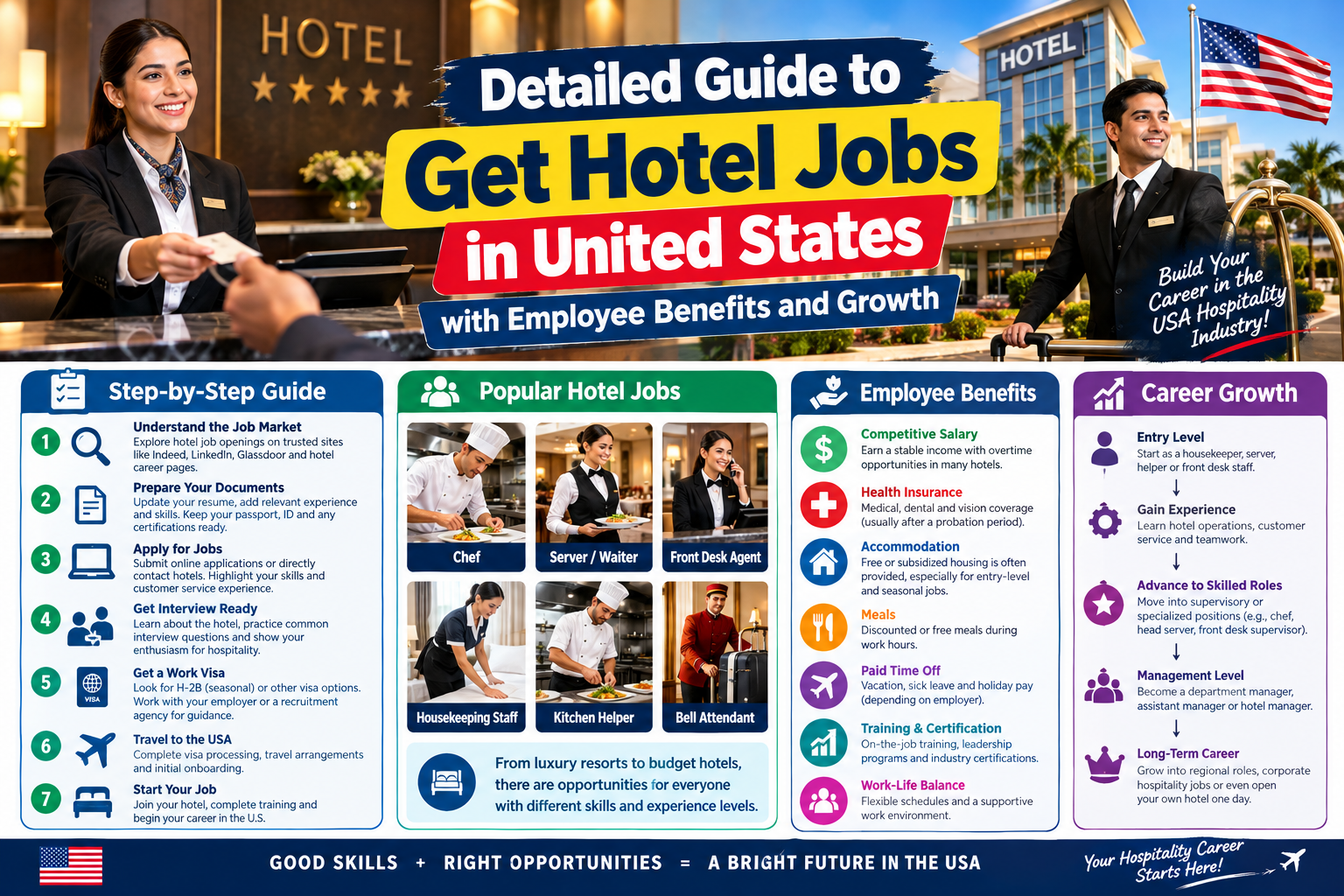
  • Detailed Guide to Get Hotel Jobs in United States with Employee Benefits and Growth

    Detailed Guide to Get Hotel Jobs in United States with Employee Benefits and Growth

    The hotel and hospitality industry is one of the major sources of employment in the United States. Hotels, resorts, motels, luxury properties, business hotels, and hospitality companies regularly hire workers for guest services, housekeeping, food and beverage, maintenance, administration, and management positions.

    For people looking for a career in hospitality, hotel jobs can offer opportunities at both entry-level and professional levels. Someone can start as a housekeeping attendant, front-desk associate, or hotel helper and eventually move into supervisory, departmental, or management positions.

    This guide explains how to get hotel jobs in the United States, what qualifications employers commonly require, potential employee benefits, career growth opportunities, salary considerations, and important information for international job seekers.

    1. Understand the Different Types of Hotel Jobs

    Before applying, identify the position that matches your experience and skills.

    Front Desk Agent

    Front-desk employees are responsible for welcoming guests, checking guests in and out, answering questions, handling reservations, and helping resolve basic guest concerns.

    Important skills include:

    • Communication
    • Customer service
    • Computer skills
    • Professional appearance
    • Problem-solving
    • Basic administrative skills

    Knowledge of hotel reservation systems can be an advantage.

    Housekeeping Attendant

    Housekeeping staff clean and maintain guest rooms and other hotel areas. Their duties may include changing linens, cleaning bathrooms, replacing supplies, and reporting maintenance problems.

    This can be a suitable entry-level position because employers may provide job-specific training.

    Hotel Concierge

    Concierge employees assist guests with information about local attractions, restaurants, transportation, reservations, and other services.

    Strong communication and knowledge of the local area are particularly useful.

    Bellhop or Guest Services Attendant

    Bellhops help guests with luggage, transportation arrangements, directions, and other basic services.

    Physical stamina and good customer-service skills are important.

    Hotel Maintenance Worker

    Maintenance employees help keep hotel buildings, rooms, equipment, and facilities operating properly.

    Employers may look for experience in areas such as:

    • Electrical work
    • Plumbing
    • HVAC
    • Carpentry
    • General repairs
    • Preventive maintenance

    Technical certifications can improve employment opportunities.

    Food and Beverage Staff

    Hotels often have restaurants, cafés, bars, banquet departments, and room-service operations.

    Possible positions include:

    • Restaurant server
    • Cook
    • Dishwasher
    • Bartender
    • Banquet server
    • Restaurant supervisor
    • Food and beverage manager

    Hotel Manager

    Hotel managers oversee daily operations and may be responsible for employees, guest satisfaction, budgets, sales, facilities, and departmental performance.

    Management positions generally require previous hospitality experience and stronger administrative and leadership skills.


    2. Check the Basic Requirements

    Hotel job requirements vary depending on the position and employer.

    Entry-level positions may not require a college degree. Employers may instead focus on:

    • Reliability
    • Customer-service skills
    • Communication
    • Teamwork
    • Flexibility
    • Professional behavior
    • Ability to follow instructions

    Professional positions can have more specific requirements.

    For example, hotel managers may benefit from hospitality management education or substantial industry experience, while maintenance roles may require technical knowledge or certifications.

    If you are applying for a front-desk position, basic computer skills and communication abilities can be particularly important.


    3. Improve Your English and Customer-Service Skills

    English communication is valuable in many hotel positions, particularly jobs involving direct interaction with guests.

    You should be comfortable with:

    • Greeting guests
    • Answering questions
    • Giving directions
    • Handling basic complaints
    • Explaining hotel services
    • Communicating with coworkers
    • Using telephone and computer systems

    If English is not your first language, practicing common hospitality conversations can help you feel more confident during interviews and at work.

    Additional language skills can also be useful in hotels serving international travelers.


    4. Prepare a Professional Resume

    A well-organized resume can make it easier for employers to understand your experience.

    Your resume should generally include:

    • Full name
    • Phone number
    • Professional email address
    • Location
    • Professional summary
    • Work experience
    • Education
    • Certifications
    • Relevant skills
    • Languages

    Customize your resume for each position.

    For a front-desk job, emphasize:

    • Customer service
    • Computer skills
    • Reservations
    • Communication
    • Cash handling
    • Guest relations

    For housekeeping, highlight:

    • Cleaning experience
    • Attention to detail
    • Time management
    • Teamwork
    • Ability to work independently

    For hotel management, emphasize:

    • Staff supervision
    • Budget management
    • Guest satisfaction
    • Operations
    • Revenue management
    • Sales
    • Leadership

    5. Get Relevant Training and Certifications

    Formal education is not required for every hotel job, but training can strengthen your application.

    Useful areas include:

    • Hospitality management
    • Customer service
    • Food safety
    • Workplace safety
    • Hotel reservation systems
    • Housekeeping procedures
    • First aid
    • Computer skills
    • Management
    • Accounting

    For technical hotel positions, relevant trade qualifications or licenses may be more important than hospitality education.

    If you want to progress into management, a degree or certificate in hospitality management, business, or a related field can be useful.


    6. Search for Hotel Jobs Online

    There are several ways to search for hotel jobs in the United States.

    Use job titles such as:

    • Hotel Front Desk Agent
    • Guest Service Agent
    • Hotel Housekeeper
    • Room Attendant
    • Hotel Concierge
    • Bell Attendant
    • Hotel Maintenance Worker
    • Hotel Cook
    • Banquet Server
    • Hotel Supervisor
    • Assistant Hotel Manager
    • Hotel Manager

    You can search major employment websites, hotel-company career pages, hospitality recruitment companies, and local job listings.

    You should also search directly on the career websites of hotel groups and individual properties.


    7. Apply Directly to Hotels and Resorts

    Direct applications can be useful because hotels frequently recruit for multiple departments.

    Potential employers include:

    • Independent hotels
    • Luxury hotels
    • Budget hotels
    • Resorts
    • Motels
    • Extended-stay properties
    • Airport hotels
    • Conference hotels
    • Vacation properties
    • Hotel management companies

    Tourist destinations and large cities can have substantial hospitality industries.

    When applying, do not focus only on one position. If you qualify for several departments, you can apply for multiple suitable roles.


    8. Understand Hotel Employee Benefits

    One major advantage of working for a hotel company can be access to employee benefits.

    However, benefits differ by employer, job level, employment status, location, and whether the employee is full-time or part-time.

    Potential benefits may include:

    Health Insurance

    Some full-time hotel employees may receive employer-sponsored medical, dental, or vision insurance.

    The exact coverage, employee contribution, eligibility requirements, and waiting periods vary by company.

    Paid Time Off

    Eligible employees may receive paid vacation, holidays, or sick leave depending on company policy and applicable law.

    Retirement Plans

    Some hotel companies offer retirement plans such as a 401(k), potentially with an employer contribution or matching program.

    Employee Hotel Discounts

    Hotel companies may provide discounted room rates for employees and, in some cases, eligible family members.

    These discounts can be valuable for employees who travel.

    Meals or Employee Dining

    Some properties may provide employee meals or discounted food, particularly resorts and large full-service hotels.

    Training and Development

    Larger hotel companies may provide internal training programs designed to help employees develop hospitality, customer-service, leadership, or management skills.

    Bonus and Incentive Programs

    Certain positions may have performance bonuses, sales incentives, service charges, or other compensation programs.

    Always review the actual benefits package before accepting a position because benefits are not identical across employers.


    9. Learn About Hotel Salaries

    Hotel salaries vary considerably based on position, location, experience, property type, and responsibilities.

    For example, entry-level hospitality positions may have lower wages than supervisory and management roles.

    The U.S. Bureau of Labor Statistics reports that lodging managers had a median annual wage of $68,130 in May 2025. The lowest 10% earned less than $39,820, while the highest 10% earned more than $127,090.

    Pay can also vary substantially between cities and states.

    When comparing hotel jobs, look beyond the advertised hourly rate. Consider:

    • Health insurance
    • Paid time off
    • Retirement benefits
    • Employee discounts
    • Overtime opportunities
    • Bonuses
    • Housing, if offered
    • Transportation costs
    • Local living expenses

    10. Build a Career Path in Hospitality

    Hotel employment does not have to remain an entry-level job.

    Many hospitality careers can follow a progression such as:

    Housekeeping Attendant → Housekeeping Supervisor → Executive Housekeeper

    Front Desk Agent → Front Desk Supervisor → Front Office Manager

    Restaurant Server → Restaurant Supervisor → Food & Beverage Manager

    Maintenance Worker → Maintenance Supervisor → Chief Engineer

    Guest Services Agent → Guest Services Supervisor → Hotel Operations Manager

    The exact career path depends on the hotel company, employee performance, qualifications, and available positions.

    Developing leadership, communication, financial, technology, and customer-service skills can help employees qualify for higher-level responsibilities.


    11. Consider Hotel Management as a Long-Term Career

    Hotel management can involve many different responsibilities.

    A lodging manager may oversee:

    • Guest services
    • Housekeeping
    • Food service
    • Maintenance
    • Staff scheduling
    • Budgets
    • Sales
    • Marketing
    • Security
    • Property operations

    The BLS projects employment of lodging managers to grow 4% from 2024 to 2034, with approximately 6,800 openings projected each year on average over that period.

    People interested in management should consider gaining experience in multiple hotel departments. Understanding front office, housekeeping, food service, sales, and operations can provide a broader understanding of hotel management.


    12. Prepare for the Hotel Job Interview

    Hotel employers may ask questions related to customer service and workplace situations.

    Common questions include:

    “How would you handle an unhappy guest?”

    Explain that you would listen carefully, remain professional, understand the issue, and follow hotel procedures to find an appropriate solution.

    “Can you work weekends and holidays?”

    Hotels operate throughout the year, so many positions require flexible schedules.

    “Why do you want to work in hospitality?”

    Discuss your interest in customer service, teamwork, travel, hospitality, or developing a long-term career.

    “Do you have experience using hotel software?”

    If you have used reservation or property-management systems, mention the specific systems you know.

    If you have no experience, explain that you are comfortable learning new software.


    13. Understand Work Authorization for International Applicants

    People outside the United States should understand an important distinction: getting a hotel job offer does not automatically provide permission to work in the United States.

    Foreign nationals generally need an appropriate immigration status or employment authorization before starting work.

    Some temporary hospitality positions may potentially qualify for programs such as the H-2B temporary nonagricultural worker program, subject to specific eligibility requirements, employer obligations, and applicable limits.

    Not every hotel job qualifies for H-2B or another employment-based immigration category.

    If you are applying from another country, look for employers that specifically indicate whether they consider international applicants and whether they can use an appropriate employment-based immigration process.

    Check current information from U.S. Citizenship and Immigration Services and the U.S. Department of Labor before making immigration or employment decisions.


    14. Watch Out for Hotel Job Scams

    International hotel job seekers should be especially careful with online offers.

    Be cautious if someone promises:

    • A guaranteed U.S. visa
    • Guaranteed employment
    • Extremely high wages for an entry-level job
    • Immediate approval without an interview
    • A visa in exchange for a large personal payment

    Never send money to an unknown person simply because they claim to have a hotel job available.

    Verify the hotel and the job independently through the employer’s official website and legitimate recruitment channels.


    15. Follow This Step-by-Step Application Process

    If you want to get a hotel job in the United States, follow a structured process.

    Step 1: Choose a Hotel Career

    Decide whether you want to work in:

    • Front office
    • Housekeeping
    • Food and beverage
    • Maintenance
    • Guest services
    • Administration
    • Management

    Step 2: Check Job Requirements

    Read the complete job description and identify the required skills, experience, education, and work authorization.

    Step 3: Improve Your Skills

    Take relevant hospitality, customer-service, technical, or language training.

    Step 4: Create Your Resume

    Prepare a clear, professional resume customized to the hotel position.

    Step 5: Search for Employers

    Search hotel companies, resorts, independent properties, and hospitality job websites.

    Step 6: Apply to Multiple Positions

    Do not depend on a single application. Apply to suitable positions that match your experience.

    Step 7: Prepare for Interviews

    Practice common hospitality interview questions and prepare examples of how you have handled customers, teamwork, and difficult situations.

    Step 8: Verify the Employment Offer

    Confirm the employer, position, salary, benefits, work location, schedule, and employment conditions.

    Step 9: Check Work Authorization

    If you are outside the United States, verify whether you have or can obtain the legal authorization required for the specific position.


    Frequently Asked Questions

    Can I get a hotel job in the United States without a college degree?

    Yes. Many entry-level hotel positions do not require a college degree. Employers may focus more on experience, communication, reliability, customer service, and job-specific skills.

    What is the easiest hotel job to start with?

    Entry-level opportunities can include housekeeping, room attendant, hotel helper, laundry attendant, dishwasher, food-service worker, or some guest-service positions. Requirements vary by employer.

    Do U.S. hotels hire foreign workers?

    Some hotels may hire foreign workers when the worker and position qualify under an applicable U.S. immigration category. However, sponsorship is not available for every position.

    Do hotel employees receive free accommodation?

    Not generally. Some resorts or seasonal properties may offer employee housing or accommodation arrangements, but this depends on the employer and location.

    Can hotel workers receive health insurance?

    Some eligible employees receive employer-sponsored health, dental, or vision benefits. Eligibility and coverage vary by company and employment status.

    Can I grow from an entry-level hotel job to management?

    Yes. Hospitality provides multiple potential career paths. Employees can move into supervisory and management roles by developing experience, leadership skills, operational knowledge, and relevant qualifications.

    Final Thoughts

    Hotel jobs in the United States can provide opportunities for people with different levels of education and professional experience. Entry-level workers can begin in housekeeping, guest services, food service, or other support roles, while experienced professionals can pursue careers in hotel operations, hospitality management, food and beverage, engineering, and administration.

    Employee benefits may include health insurance, paid time off, retirement plans, employee hotel discounts, training programs, and other benefits, but the exact package depends on the employer and employment status.

    For long-term career growth, focus on developing customer-service, communication, leadership, technology, and operational skills. Starting in an entry-level position does not necessarily mean staying at that level; hospitality companies can provide opportunities to move into supervisory and management positions as experience and qualifications increase.

    International applicants should pay particular attention to work authorization. A hotel job offer alone does not automatically provide permission to work in the United States. Always verify current immigration requirements through official U.S. government resources before paying recruiters, accepting an offer, or making travel arrangements.