Security guard jobs are an important part of the private security industry in the United States. Security professionals work in office buildings, shopping centers, hotels, hospitals, residential communities, warehouses, construction sites, educational institutions, and many other locations.
For people looking for a career that does not always require a college degree, security work can be an option worth exploring. However, requirements are not identical across the United States. Security guards are generally regulated at the state level, and applicants may need to complete background checks, training, licensing, registration, or certification depending on where they want to work.
This guide explains how to become a security guard in the United States, what training and certifications may be required, how to find jobs, what employers look for, salary information, and what international applicants should know about work authorization.
Important: Security-guard licensing requirements vary by state and sometimes by job type. Always check the current requirements of the state licensing authority before paying for training or accepting a position.
What Does a Security Guard Do?
Security guards help protect people, property, buildings, and businesses. Their exact duties depend on the employer and assignment.
Common responsibilities include:
- Monitoring entrances and exits
- Checking identification
- Patrolling buildings and property
- Monitoring security cameras
- Writing incident reports
- Responding to alarms
- Preventing unauthorized access
- Protecting property
- Assisting during emergencies
- Reporting suspicious activity
- Enforcing site-specific security procedures
Security guards may work independently or as part of a larger security team.
Some positions are primarily focused on observation and reporting, while others involve access control, patrols, customer service, or specialized security responsibilities.
Types of Security Guard Jobs in the USA
There are many different security positions available.
Unarmed Security Guard
Unarmed guards generally protect property and people without carrying a firearm as part of their job.
Typical assignments include:
- Office buildings
- Retail stores
- Residential communities
- Hotels
- Warehouses
- Construction sites
- Hospitals
These positions can be suitable for people entering the private security industry.
Armed Security Guard
Armed security positions involve additional requirements because the employee carries a firearm while performing security duties.
Depending on the state, an applicant may need additional firearms training, licensing, background checks, and authorization.
Armed security jobs should not be treated as ordinary entry-level security positions because the legal and training requirements can be significantly different.
Corporate Security
Corporate security guards or officers may work in office buildings and corporate facilities.
Their responsibilities can include access control, visitor management, patrols, emergency response, and security monitoring.
Hospital Security
Healthcare facilities employ security personnel to help maintain a safe environment for patients, visitors, and employees.
Hospital security can involve dealing with difficult situations, monitoring entrances, responding to incidents, and working closely with healthcare staff.
Event Security
Event security personnel can work at:
- Concerts
- Sports events
- Conferences
- Festivals
- Large public gatherings
Their responsibilities may include crowd monitoring, access control, ticket-area security, and assisting with emergency procedures.
Security Guard Requirements in the United States
There is no single nationwide security-guard license that applies to every private security worker.
Requirements are primarily determined by state law.
Depending on the state and position, applicants may need to meet requirements involving:
- Minimum age
- Identification
- Background checks
- Fingerprinting
- Training
- Licensing or registration
- Criminal-history requirements
- Employment eligibility
- Additional qualifications for armed positions
Some states have detailed training requirements, while others have different licensing structures.
Therefore, the first step should be identifying where you want to work.
Step 1: Choose Your State
Before enrolling in a security-guard training course, determine which state you intend to work in.
Search for the official state agency responsible for regulating private security.
For example, requirements can differ between California, Texas, Florida, New York, Illinois, and other states.
Do not assume that a security license from one state automatically allows you to work in another state.
Some employers may also have additional requirements beyond the minimum state licensing standards.
Step 2: Check the Minimum Age Requirement
Many states require security guards to meet a minimum age requirement.
The exact age depends on the state and sometimes on the type of security work.
Armed security positions can have additional age and licensing requirements.
Check the applicable state rules before applying.
Step 3: Complete Required Training
Training is an important part of becoming a security guard.
Depending on the state, training may cover subjects such as:
- Security officer responsibilities
- Legal powers and limitations
- Ethics
- Communication
- Emergency procedures
- Report writing
- Access control
- Patrol procedures
- Observation skills
- Workplace safety
- Conflict management
- First aid or CPR
- Use-of-force laws
The required number of training hours can vary considerably.
Some states require training before employment, while others allow an employer to provide certain training after hiring.
Security Guard Certification and Licensing
The words certification, registration, and license can have different meanings depending on the state.
In some locations, a security guard must obtain a state registration or license. In others, an employer may have specific certification requirements.
You should always determine:
- Which government agency regulates security guards in your state?
- Is a license or registration required?
- What training is mandatory?
- Is fingerprinting required?
- Is a background check required?
- Does the employer require additional certification?
This prevents you from paying for a course that does not satisfy your state’s requirements.
First Aid and CPR Certification
First aid and CPR training can be useful for security professionals.
Security officers may be among the first employees to respond when someone becomes injured or experiences a medical emergency.
Some employers require or prefer first aid and CPR certification, especially for security positions in:
- Schools
- Hospitals
- Residential communities
- Large facilities
- Public venues
Even where certification is not legally required, relevant training can strengthen a candidate’s resume.
Skills Employers Look For
A successful security guard needs more than physical strength.
Important skills include:
Communication
Security guards regularly communicate with employees, visitors, customers, supervisors, law enforcement, and emergency personnel.
Observation
Security work requires paying attention to unusual behavior, access issues, safety concerns, and potential security problems.
Report Writing
Security officers frequently document incidents, observations, and daily activities.
Clear and accurate writing is therefore important.
Professionalism
Security personnel often represent the company or client at the location where they work.
Professional behavior and appearance can be important.
Conflict Management
Security guards may encounter disagreements or difficult situations.
The ability to remain calm, communicate clearly, and follow established procedures is valuable.
Reliability
Security operations depend heavily on employees arriving on time and completing assigned shifts.
Employers may place significant importance on attendance and reliability.
Do You Need Previous Experience?
Not always.
Some entry-level security jobs provide training to new employees.
However, previous experience in areas such as:
- Customer service
- Military service
- Law enforcement
- Hospitality
- Retail
- Safety
- Emergency response
may be useful depending on the position.
Specialized security jobs can require additional experience or qualifications.
Security Guard Salary in the United States
Security guard compensation varies by state, employer, experience, assignment, and schedule.
According to the U.S. Bureau of Labor Statistics, the median annual wage for security guards was $38,370 in May 2025. The BLS reports that the lowest 10 percent earned less than $30,390, while the highest 10 percent earned more than $59,400. (bls.gov)
The BLS also projects approximately 162,300 openings for security guards each year on average from 2024 to 2034, primarily due to workers leaving the occupation and needing replacement. (bls.gov)
Actual wages can differ substantially based on location and assignment.
For example, specialized security positions, overnight shifts, supervisory jobs, and assignments in higher-cost areas may have different compensation.
Where Security Guards Work
Security guards work across many industries.
Common workplaces include:
- Office buildings
- Retail stores
- Shopping centers
- Hospitals
- Hotels
- Schools
- Universities
- Warehouses
- Manufacturing facilities
- Construction sites
- Residential communities
- Airports
- Government facilities
- Entertainment venues
The requirements and responsibilities can differ considerably between locations.
How to Find Security Guard Jobs in the USA
Search Online Job Platforms
Use search terms such as:
- Security guard jobs USA
- Security officer jobs
- Unarmed security jobs
- Security jobs near me
- Entry-level security jobs
- Security officer hiring
- Security guard jobs no experience
Filter results by state and city.
Apply Directly to Security Companies
Many private security companies recruit employees through their own websites.
Look for career pages containing terms such as:
- Security Officer
- Security Guard
- Patrol Officer
- Site Security Officer
- Security Specialist
Read the job requirements carefully before applying.
Search Individual Employers
Hospitals, hotels, universities, warehouses, shopping centers, and manufacturing companies may advertise security positions directly.
Some large organizations use in-house security departments, while others hire private security contractors.
How to Prepare a Security Guard Resume
Your resume should be simple and professional.
Include:
Professional Summary: Briefly describe your security, customer-service, military, or related experience.
Work Experience: List previous employers, job titles, dates, and responsibilities.
Certifications: Include relevant security training, CPR, first aid, or other certifications.
Skills: Mention observation, communication, report writing, access control, conflict management, and computer skills.
Education: List relevant educational qualifications.
If you have no previous security experience, emphasize transferable skills from retail, hospitality, customer service, military, or other jobs.
How to Prepare for a Security Guard Interview
Security interviews may include questions about difficult situations.
For example:
“What would you do if you saw suspicious activity?”
A good response should focus on following company procedures, maintaining personal and public safety, documenting the incident, and contacting the appropriate supervisor or emergency service when required.
“How would you handle an angry visitor?”
Explain that you would remain calm, communicate professionally, avoid unnecessary confrontation, and follow site procedures.
“Can you work overnight or weekends?”
Security operations often run around the clock. Be honest about your availability.
Work Schedules for Security Guards
Security facilities frequently operate 24 hours a day.
Security guards may therefore work:
- Morning shifts
- Afternoon shifts
- Overnight shifts
- Weekends
- Holidays
- Rotating schedules
The BLS notes that security guards often work around the clock, including nights, weekends, and holidays. (bls.gov)
Before accepting a job, confirm the expected schedule and whether overtime is available.
Can Foreign Workers Get Security Guard Jobs in the USA?
International applicants need to understand that obtaining a security guard position is not the same as obtaining authorization to work in the United States.
A foreign national generally needs an appropriate immigration status or employment authorization that permits the specific employment.
Security guard positions also involve state-specific licensing and background requirements.
Because of these factors, international applicants should first determine whether they have legal authorization to work in the United States and whether they satisfy the security licensing requirements of the state where they want to work.
A job offer by itself does not automatically provide U.S. work authorization.
Security Guard Jobs and Visa Sponsorship
Applicants should be particularly careful about advertisements claiming to provide “guaranteed security guard visa sponsorship.”
There is no general U.S. visa that automatically applies simply because someone wants to work as a security guard.
Temporary employment categories have specific eligibility requirements, and an employer must satisfy the requirements of the relevant immigration program.
If an employer claims that it can sponsor you, ask for detailed written information about:
- Employer identity
- Job location
- Job title
- Salary
- Contract period
- Visa category
- Immigration process
- Recruitment fees
- Employment conditions
Verify the information independently before paying money or signing a contract.
How to Avoid Security Job Scams
International job seekers should be cautious about fake security recruitment agencies.
Warning signs include:
- Guaranteed visa approval
- Guaranteed permanent residency
- Extremely high salaries for entry-level work
- Requests for large upfront payments
- No interview
- No written contract
- Requests for payment through personal accounts
- Unofficial email addresses
- Pressure to make immediate payments
Never assume that a recruiter can guarantee immigration approval.
Research the employer and verify immigration information through official U.S. government sources.
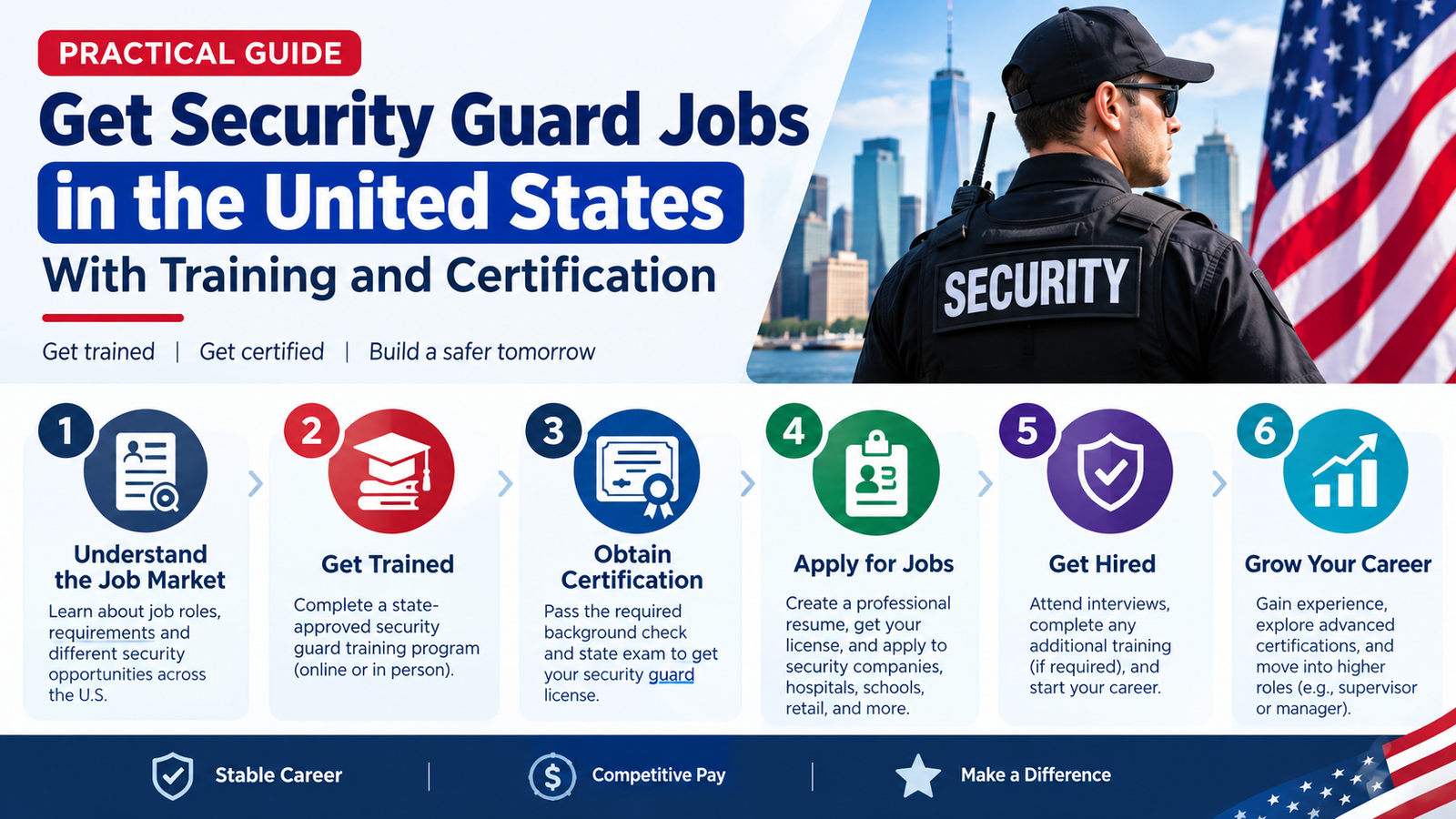
Step-by-Step Plan to Become a Security Guard
If you want to start a security career in the United States, follow this general process:
Step 1: Choose the state where you want to work.
Step 2: Find the official state security-licensing authority.
Step 3: Check age, background, training, and licensing requirements.
Step 4: Complete any required security training.
Step 5: Complete fingerprinting or background checks if required.
Step 6: Obtain the required registration or license.
Step 7: Prepare your resume.
Step 8: Apply to security companies and employers.
Step 9: Complete interviews and employer-specific training.
Step 10: Maintain your license and required certifications.
Frequently Asked Questions
Do you need a degree to become a security guard?
Generally, a college degree is not required for entry-level security guard positions. Requirements vary by state and employer.
Do security guards need certification?
Requirements vary by state. Some states require registration, licensing, or specific training. Employers may also require additional certifications.
How much does a security guard make in the USA?
The BLS reported a median annual wage of $38,370 in May 2025. Actual pay depends on location, employer, experience, assignment, and schedule. (bls.gov)
Can I become a security guard without experience?
Yes. Some employers hire entry-level applicants and provide training. Previous customer-service, military, safety, or related experience can be helpful.
Do armed guards need additional training?
Typically, armed security positions have additional requirements involving firearms training and authorization. The exact requirements depend on state law and the employer.
Can foreigners get security guard jobs in the United States?
Foreign nationals may work in the United States only when they have appropriate work authorization or immigration status. They must also satisfy applicable state security requirements.
Are security guard jobs available at night?
Yes. Many security operations run 24 hours a day, so overnight and weekend positions are common. (bls.gov)
Final Thoughts
Security guard work can provide an entry point into the private security industry without necessarily requiring a college degree. However, applicants need to understand that security licensing and training requirements differ from state to state.
The best starting point is to decide where you want to work and then check the requirements of the relevant state licensing authority. After completing required training and background procedures, you can begin applying to security companies, businesses, hospitals, hotels, residential communities, warehouses, and other employers.
Developing strong communication, observation, report-writing, customer-service, and conflict-management skills can make your application more competitive. Additional training such as first aid or CPR may also be useful depending on the position.
For international applicants, work authorization is a separate issue from professional qualification. Before accepting a U.S. security job, verify that you are legally authorized to work and that you meet the licensing requirements for the state and position.
Finally, be careful with recruitment agencies that promise guaranteed U.S. jobs or visas. Verify employers, contracts, training requirements, and immigration information before paying any fees.
With proper training, the appropriate state credentials, a professional resume, and a consistent job-search strategy, candidates can approach the U.S. security employment market in a more informed and organized way.
Disclaimer: This article is for general informational purposes only and is not legal, immigration, employment, or security-training advice. Licensing, training, work-authorization, and immigration requirements can change and vary by state and individual circumstances. Always verify current requirements with the relevant state authority and official U.S. government sources.
Leave a Reply