Category: USA JOBS

  • Complete Guide to Get Hospitality Jobs in United States in Hotels, Restaurants, and Resorts

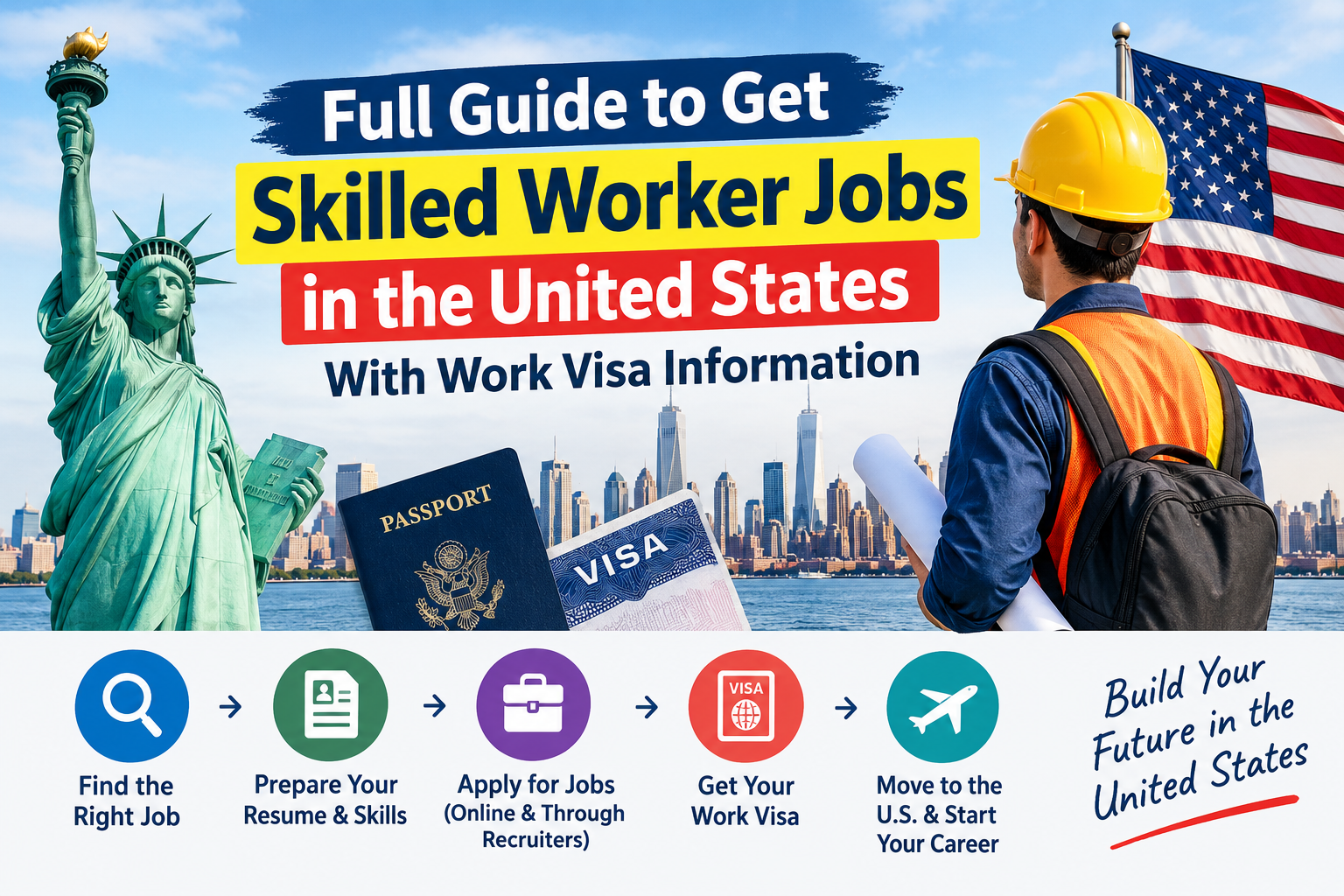
    Complete Guide to Get Hospitality Jobs in United States in Hotels, Restaurants, and Resorts

    The hospitality industry is one of the largest service industries in the United States and provides employment opportunities in hotels, restaurants, resorts, event venues, and other travel-related businesses. Hospitality jobs are available for both experienced professionals and people looking for entry-level work.

    Common positions include hotel front-desk agents, housekeepers, chefs, cooks, servers, bartenders, resort staff, maintenance workers, guest-service representatives, and hospitality managers.

    If you are interested in building a career in the U.S. hospitality industry, understanding the available jobs, requirements, salaries, application process, and work authorization rules can help you prepare effectively.

    1. Types of Hospitality Jobs in the United States

    Hospitality is a broad industry with many different career options.

    Hotel Jobs

    Hotels regularly hire workers for departments such as:

    • Front desk and guest services
    • Housekeeping
    • Concierge services
    • Food and beverage
    • Maintenance
    • Reservations
    • Sales and marketing
    • Hotel management

    Entry-level positions such as room attendant, housekeeping worker, and hotel helper may require limited previous experience, while management positions generally require hospitality experience and stronger leadership skills.

    Restaurant Jobs

    Restaurants offer opportunities for people with culinary and customer-service skills.

    Common positions include:

    • Chef
    • Sous chef
    • Line cook
    • Prep cook
    • Server
    • Host or hostess
    • Food runner
    • Dishwasher
    • Restaurant manager

    Restaurant experience can also provide a pathway toward supervisory and management positions.

    Resort Jobs

    Resorts often employ workers across several departments, including:

    • Guest services
    • Housekeeping
    • Restaurants
    • Bars
    • Recreation
    • Spa services
    • Maintenance
    • Events
    • Front office

    Resort employment can be particularly relevant in destinations that attract tourists throughout the year or during specific seasons.

    2. Check the Basic Job Requirements

    Requirements depend on the position and employer.

    Entry-level hospitality jobs may focus on:

    • Reliability
    • Communication
    • Customer service
    • Teamwork
    • Flexibility
    • Ability to follow instructions
    • Professional behavior

    For specialized jobs, employers may require previous experience, education, or certifications.

    For example, chefs may need substantial kitchen experience, while maintenance workers may need technical skills. Hotel managers may have hospitality-management education or several years of industry experience.

    3. Improve Your English and Customer-Service Skills

    Strong communication skills are valuable in hospitality because employees frequently interact with guests and coworkers.

    Workers should be able to:

    • Welcome customers
    • Answer questions
    • Explain services
    • Take reservations or orders
    • Handle basic complaints
    • Communicate with team members
    • Follow workplace instructions

    If English is not your first language, practicing common hospitality conversations can improve your confidence during interviews and at work.

    Additional language skills can also be useful in hotels and resorts that serve international visitors.

    4. Prepare a Professional Resume

    A good resume is important when applying for hospitality jobs.

    Include:

    • Name and contact information
    • Professional summary
    • Work experience
    • Education
    • Certifications
    • Relevant skills
    • Languages

    Customize your resume for the position.

    For a hotel front-desk job, emphasize customer service, computer skills, reservations, and communication.

    For housekeeping, highlight cleaning experience, attention to detail, time management, and reliability.

    For restaurant jobs, mention food preparation, customer service, POS systems, food safety, and previous restaurant experience.

    For management positions, emphasize leadership, staff supervision, budgets, operations, sales, and customer satisfaction.

    5. Get Relevant Training

    Training can improve your chances of getting hired and progressing in the industry.

    Useful areas include:

    • Hospitality management
    • Customer service
    • Food safety
    • Food handling
    • Workplace safety
    • Computer skills
    • Hotel reservation systems
    • Culinary skills
    • Leadership

    Not every hospitality job requires formal education. Many entry-level workers receive training directly from their employer.

    However, specialized qualifications can be valuable for professional positions and long-term career development.

    6. Search for Hospitality Jobs Online

    Use specific job titles when searching for employment.

    Examples include:

    • Hotel Front Desk Agent
    • Guest Service Agent
    • Hotel Housekeeper
    • Room Attendant
    • Hotel Concierge
    • Restaurant Server
    • Line Cook
    • Chef
    • Resort Worker
    • Hospitality Supervisor
    • Hotel Manager
    • Restaurant Manager

    Search on major employment websites, hotel and restaurant career pages, hospitality recruitment agencies, and company websites.

    You can also search by location, such as:

    “Hospitality jobs in New York”

    “Hotel jobs in Florida”

    “Restaurant jobs in Texas”

    “Resort jobs in California”

    Adding the city or state can help you find opportunities that match your preferred location.

    7. Apply Directly to Hotels, Restaurants, and Resorts

    Do not rely only on general job websites.

    Visit the official career pages of hotels, restaurant groups, resorts, and hospitality companies. Large companies may have openings across several departments.

    When applying, carefully read the job description and make sure your experience matches the requirements.

    Applying to several suitable positions can increase your chances of receiving an interview.

    8. Understand Hospitality Pay and Benefits

    Hospitality pay varies according to job title, location, experience, employer, working hours, and tips.

    Management and specialized positions generally have different compensation structures from entry-level roles.

    Some hospitality employees may also receive benefits such as:

    • Health insurance
    • Dental and vision coverage
    • Paid time off
    • Retirement plans
    • Employee discounts
    • Hotel room discounts
    • Training programs
    • Performance bonuses

    Benefits are not identical across employers, so review the complete compensation package before accepting a job.

    Tipped workers should also understand how tips and base wages are handled by their employer and under applicable state and federal rules.

    9. Build a Hospitality Career

    Hospitality can offer opportunities for career progression.

    For example:

    Housekeeper → Housekeeping Supervisor → Executive Housekeeper

    Front Desk Agent → Front Desk Supervisor → Front Office Manager

    Server → Restaurant Supervisor → Restaurant Manager

    Cook → Sous Chef → Executive Chef

    Guest Services Agent → Supervisor → Hotel Operations Manager

    Career progression depends on experience, performance, qualifications, and available opportunities.

    Developing leadership, communication, technology, financial, and customer-service skills can help employees qualify for more senior positions.

    10. Information for International Job Seekers

    People living outside the United States should understand that receiving a job offer does not automatically provide permission to work in the country.

    Foreign workers need an appropriate immigration status or employment authorization before legally starting employment.

    Some temporary hospitality positions may potentially qualify for programs such as the H-2B temporary nonagricultural worker program, subject to eligibility requirements, employer obligations, and applicable limits.

    Not every hotel, restaurant, or resort position qualifies for visa sponsorship.

    If you are applying internationally, look for employers that clearly explain whether they consider foreign applicants and whether they can use an applicable employment-based immigration process.

    Always verify current requirements through official U.S. government sources before paying a recruiter or making travel arrangements.

    11. Avoid Hospitality Job Scams

    International job seekers should be careful when receiving employment offers online.

    Be suspicious of anyone promising:

    • Guaranteed U.S. employment
    • Guaranteed visas
    • Extremely high salaries without an interview
    • Employment after paying a large upfront fee
    • Fake contracts
    • Immediate visa approval

    Verify the employer independently and use official company websites whenever possible.

    Never send money or sensitive financial information to an unknown person simply because they claim to have a hospitality job.

    12. Step-by-Step Process to Get a Hospitality Job

    Follow these steps to organize your job search:

    Step 1: Choose your preferred hospitality field.

    Step 2: Identify the job titles that match your experience.

    Step 3: Check education, experience, language, and certification requirements.

    Step 4: Create a professional, customized resume.

    Step 5: Improve relevant hospitality and communication skills.

    Step 6: Search hotel, restaurant, and resort vacancies.

    Step 7: Apply to multiple legitimate employers.

    Step 8: Prepare for interviews and practical assessments.

    Step 9: Verify salary, benefits, working hours, and job duties.

    Step 10: Confirm that you have the legal authorization required to work in the United States.

    Frequently Asked Questions

    Can I get a hospitality job without experience?

    Yes. Some entry-level positions in hotels, restaurants, and resorts provide on-the-job training and may not require previous industry experience.

    Can foreigners get hospitality jobs in the United States?

    Foreign workers can work legally in the United States when they qualify for an appropriate immigration status or employment authorization. Sponsorship is not available for every hospitality position.

    Which hospitality jobs can offer career growth?

    Front office, housekeeping, food and beverage, culinary, guest services, maintenance, sales, and management can all provide potential career-development paths.

    Do hospitality jobs provide employee benefits?

    Some employers offer health insurance, paid time off, retirement plans, employee discounts, hotel discounts, and other benefits. Eligibility depends on the employer and employment status.

    Final Thoughts

    Hospitality jobs in the United States provide opportunities across hotels, restaurants, resorts, and other service businesses. Whether you are an experienced chef, hotel professional, restaurant worker, or someone looking for an entry-level position, there are different career paths to explore.

    The best way to improve your opportunities is to develop relevant skills, prepare a strong resume, apply through legitimate employers, and understand the requirements of each position.

    International applicants should pay particular attention to work authorization and should never assume that a job offer automatically provides a U.S. work visa. Always verify current immigration and employment requirements through official government resources before accepting an offer.

  • Detailed Guide to Get Hotel Jobs in United States with Employee Benefits and Growth

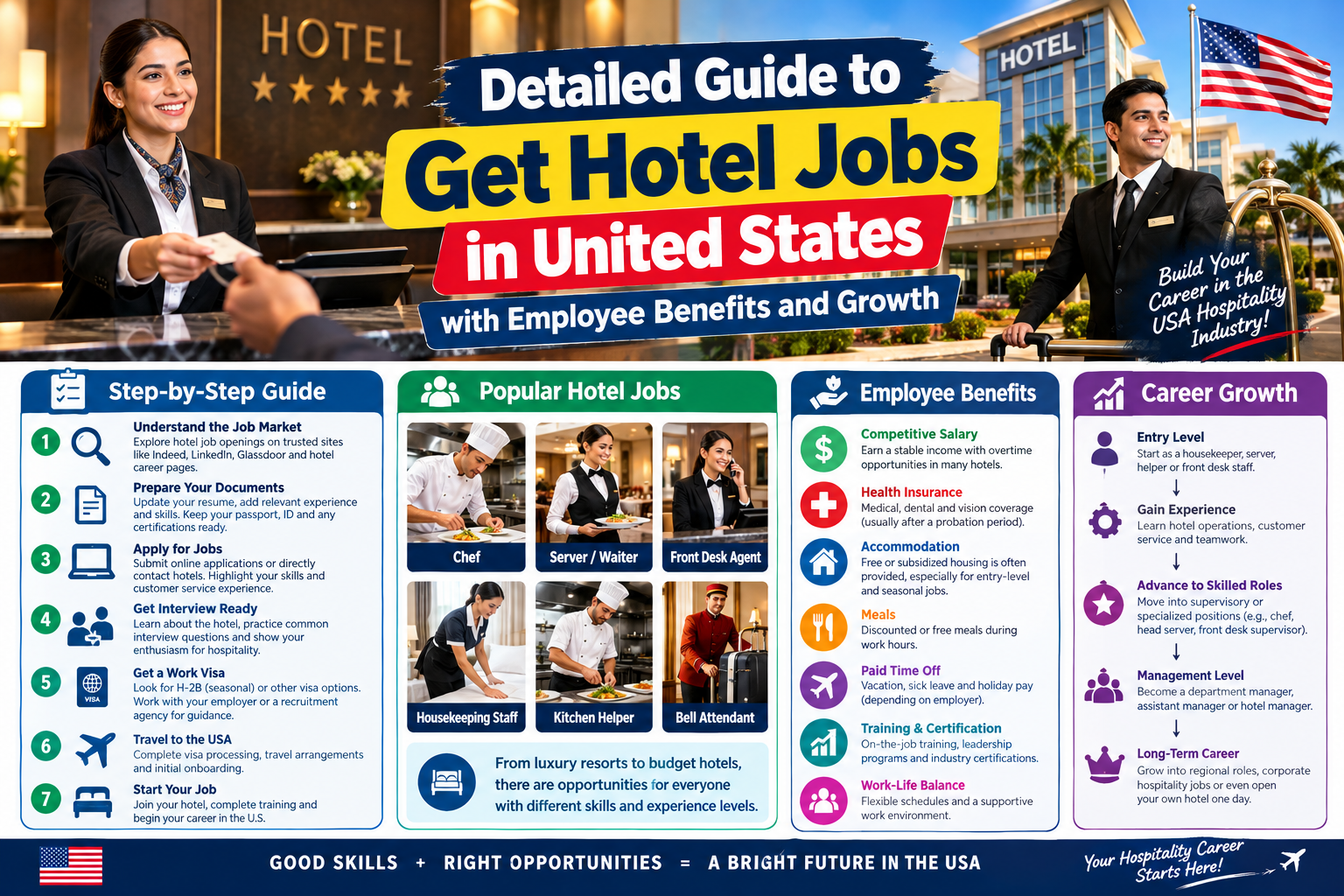
    Detailed Guide to Get Hotel Jobs in United States with Employee Benefits and Growth

    The hotel and hospitality industry is one of the major sources of employment in the United States. Hotels, resorts, motels, luxury properties, business hotels, and hospitality companies regularly hire workers for guest services, housekeeping, food and beverage, maintenance, administration, and management positions.

    For people looking for a career in hospitality, hotel jobs can offer opportunities at both entry-level and professional levels. Someone can start as a housekeeping attendant, front-desk associate, or hotel helper and eventually move into supervisory, departmental, or management positions.

    This guide explains how to get hotel jobs in the United States, what qualifications employers commonly require, potential employee benefits, career growth opportunities, salary considerations, and important information for international job seekers.

    1. Understand the Different Types of Hotel Jobs

    Before applying, identify the position that matches your experience and skills.

    Front Desk Agent

    Front-desk employees are responsible for welcoming guests, checking guests in and out, answering questions, handling reservations, and helping resolve basic guest concerns.

    Important skills include:

    • Communication
    • Customer service
    • Computer skills
    • Professional appearance
    • Problem-solving
    • Basic administrative skills

    Knowledge of hotel reservation systems can be an advantage.

    Housekeeping Attendant

    Housekeeping staff clean and maintain guest rooms and other hotel areas. Their duties may include changing linens, cleaning bathrooms, replacing supplies, and reporting maintenance problems.

    This can be a suitable entry-level position because employers may provide job-specific training.

    Hotel Concierge

    Concierge employees assist guests with information about local attractions, restaurants, transportation, reservations, and other services.

    Strong communication and knowledge of the local area are particularly useful.

    Bellhop or Guest Services Attendant

    Bellhops help guests with luggage, transportation arrangements, directions, and other basic services.

    Physical stamina and good customer-service skills are important.

    Hotel Maintenance Worker

    Maintenance employees help keep hotel buildings, rooms, equipment, and facilities operating properly.

    Employers may look for experience in areas such as:

    • Electrical work
    • Plumbing
    • HVAC
    • Carpentry
    • General repairs
    • Preventive maintenance

    Technical certifications can improve employment opportunities.

    Food and Beverage Staff

    Hotels often have restaurants, cafés, bars, banquet departments, and room-service operations.

    Possible positions include:

    • Restaurant server
    • Cook
    • Dishwasher
    • Bartender
    • Banquet server
    • Restaurant supervisor
    • Food and beverage manager

    Hotel Manager

    Hotel managers oversee daily operations and may be responsible for employees, guest satisfaction, budgets, sales, facilities, and departmental performance.

    Management positions generally require previous hospitality experience and stronger administrative and leadership skills.


    2. Check the Basic Requirements

    Hotel job requirements vary depending on the position and employer.

    Entry-level positions may not require a college degree. Employers may instead focus on:

    • Reliability
    • Customer-service skills
    • Communication
    • Teamwork
    • Flexibility
    • Professional behavior
    • Ability to follow instructions

    Professional positions can have more specific requirements.

    For example, hotel managers may benefit from hospitality management education or substantial industry experience, while maintenance roles may require technical knowledge or certifications.

    If you are applying for a front-desk position, basic computer skills and communication abilities can be particularly important.


    3. Improve Your English and Customer-Service Skills

    English communication is valuable in many hotel positions, particularly jobs involving direct interaction with guests.

    You should be comfortable with:

    • Greeting guests
    • Answering questions
    • Giving directions
    • Handling basic complaints
    • Explaining hotel services
    • Communicating with coworkers
    • Using telephone and computer systems

    If English is not your first language, practicing common hospitality conversations can help you feel more confident during interviews and at work.

    Additional language skills can also be useful in hotels serving international travelers.


    4. Prepare a Professional Resume

    A well-organized resume can make it easier for employers to understand your experience.

    Your resume should generally include:

    • Full name
    • Phone number
    • Professional email address
    • Location
    • Professional summary
    • Work experience
    • Education
    • Certifications
    • Relevant skills
    • Languages

    Customize your resume for each position.

    For a front-desk job, emphasize:

    • Customer service
    • Computer skills
    • Reservations
    • Communication
    • Cash handling
    • Guest relations

    For housekeeping, highlight:

    • Cleaning experience
    • Attention to detail
    • Time management
    • Teamwork
    • Ability to work independently

    For hotel management, emphasize:

    • Staff supervision
    • Budget management
    • Guest satisfaction
    • Operations
    • Revenue management
    • Sales
    • Leadership

    5. Get Relevant Training and Certifications

    Formal education is not required for every hotel job, but training can strengthen your application.

    Useful areas include:

    • Hospitality management
    • Customer service
    • Food safety
    • Workplace safety
    • Hotel reservation systems
    • Housekeeping procedures
    • First aid
    • Computer skills
    • Management
    • Accounting

    For technical hotel positions, relevant trade qualifications or licenses may be more important than hospitality education.

    If you want to progress into management, a degree or certificate in hospitality management, business, or a related field can be useful.


    6. Search for Hotel Jobs Online

    There are several ways to search for hotel jobs in the United States.

    Use job titles such as:

    • Hotel Front Desk Agent
    • Guest Service Agent
    • Hotel Housekeeper
    • Room Attendant
    • Hotel Concierge
    • Bell Attendant
    • Hotel Maintenance Worker
    • Hotel Cook
    • Banquet Server
    • Hotel Supervisor
    • Assistant Hotel Manager
    • Hotel Manager

    You can search major employment websites, hotel-company career pages, hospitality recruitment companies, and local job listings.

    You should also search directly on the career websites of hotel groups and individual properties.


    7. Apply Directly to Hotels and Resorts

    Direct applications can be useful because hotels frequently recruit for multiple departments.

    Potential employers include:

    • Independent hotels
    • Luxury hotels
    • Budget hotels
    • Resorts
    • Motels
    • Extended-stay properties
    • Airport hotels
    • Conference hotels
    • Vacation properties
    • Hotel management companies

    Tourist destinations and large cities can have substantial hospitality industries.

    When applying, do not focus only on one position. If you qualify for several departments, you can apply for multiple suitable roles.


    8. Understand Hotel Employee Benefits

    One major advantage of working for a hotel company can be access to employee benefits.

    However, benefits differ by employer, job level, employment status, location, and whether the employee is full-time or part-time.

    Potential benefits may include:

    Health Insurance

    Some full-time hotel employees may receive employer-sponsored medical, dental, or vision insurance.

    The exact coverage, employee contribution, eligibility requirements, and waiting periods vary by company.

    Paid Time Off

    Eligible employees may receive paid vacation, holidays, or sick leave depending on company policy and applicable law.

    Retirement Plans

    Some hotel companies offer retirement plans such as a 401(k), potentially with an employer contribution or matching program.

    Employee Hotel Discounts

    Hotel companies may provide discounted room rates for employees and, in some cases, eligible family members.

    These discounts can be valuable for employees who travel.

    Meals or Employee Dining

    Some properties may provide employee meals or discounted food, particularly resorts and large full-service hotels.

    Training and Development

    Larger hotel companies may provide internal training programs designed to help employees develop hospitality, customer-service, leadership, or management skills.

    Bonus and Incentive Programs

    Certain positions may have performance bonuses, sales incentives, service charges, or other compensation programs.

    Always review the actual benefits package before accepting a position because benefits are not identical across employers.


    9. Learn About Hotel Salaries

    Hotel salaries vary considerably based on position, location, experience, property type, and responsibilities.

    For example, entry-level hospitality positions may have lower wages than supervisory and management roles.

    The U.S. Bureau of Labor Statistics reports that lodging managers had a median annual wage of $68,130 in May 2025. The lowest 10% earned less than $39,820, while the highest 10% earned more than $127,090.

    Pay can also vary substantially between cities and states.

    When comparing hotel jobs, look beyond the advertised hourly rate. Consider:

    • Health insurance
    • Paid time off
    • Retirement benefits
    • Employee discounts
    • Overtime opportunities
    • Bonuses
    • Housing, if offered
    • Transportation costs
    • Local living expenses

    10. Build a Career Path in Hospitality

    Hotel employment does not have to remain an entry-level job.

    Many hospitality careers can follow a progression such as:

    Housekeeping Attendant → Housekeeping Supervisor → Executive Housekeeper

    Front Desk Agent → Front Desk Supervisor → Front Office Manager

    Restaurant Server → Restaurant Supervisor → Food & Beverage Manager

    Maintenance Worker → Maintenance Supervisor → Chief Engineer

    Guest Services Agent → Guest Services Supervisor → Hotel Operations Manager

    The exact career path depends on the hotel company, employee performance, qualifications, and available positions.

    Developing leadership, communication, financial, technology, and customer-service skills can help employees qualify for higher-level responsibilities.


    11. Consider Hotel Management as a Long-Term Career

    Hotel management can involve many different responsibilities.

    A lodging manager may oversee:

    • Guest services
    • Housekeeping
    • Food service
    • Maintenance
    • Staff scheduling
    • Budgets
    • Sales
    • Marketing
    • Security
    • Property operations

    The BLS projects employment of lodging managers to grow 4% from 2024 to 2034, with approximately 6,800 openings projected each year on average over that period.

    People interested in management should consider gaining experience in multiple hotel departments. Understanding front office, housekeeping, food service, sales, and operations can provide a broader understanding of hotel management.


    12. Prepare for the Hotel Job Interview

    Hotel employers may ask questions related to customer service and workplace situations.

    Common questions include:

    “How would you handle an unhappy guest?”

    Explain that you would listen carefully, remain professional, understand the issue, and follow hotel procedures to find an appropriate solution.

    “Can you work weekends and holidays?”

    Hotels operate throughout the year, so many positions require flexible schedules.

    “Why do you want to work in hospitality?”

    Discuss your interest in customer service, teamwork, travel, hospitality, or developing a long-term career.

    “Do you have experience using hotel software?”

    If you have used reservation or property-management systems, mention the specific systems you know.

    If you have no experience, explain that you are comfortable learning new software.


    13. Understand Work Authorization for International Applicants

    People outside the United States should understand an important distinction: getting a hotel job offer does not automatically provide permission to work in the United States.

    Foreign nationals generally need an appropriate immigration status or employment authorization before starting work.

    Some temporary hospitality positions may potentially qualify for programs such as the H-2B temporary nonagricultural worker program, subject to specific eligibility requirements, employer obligations, and applicable limits.

    Not every hotel job qualifies for H-2B or another employment-based immigration category.

    If you are applying from another country, look for employers that specifically indicate whether they consider international applicants and whether they can use an appropriate employment-based immigration process.

    Check current information from U.S. Citizenship and Immigration Services and the U.S. Department of Labor before making immigration or employment decisions.


    14. Watch Out for Hotel Job Scams

    International hotel job seekers should be especially careful with online offers.

    Be cautious if someone promises:

    • A guaranteed U.S. visa
    • Guaranteed employment
    • Extremely high wages for an entry-level job
    • Immediate approval without an interview
    • A visa in exchange for a large personal payment

    Never send money to an unknown person simply because they claim to have a hotel job available.

    Verify the hotel and the job independently through the employer’s official website and legitimate recruitment channels.


    15. Follow This Step-by-Step Application Process

    If you want to get a hotel job in the United States, follow a structured process.

    Step 1: Choose a Hotel Career

    Decide whether you want to work in:

    • Front office
    • Housekeeping
    • Food and beverage
    • Maintenance
    • Guest services
    • Administration
    • Management

    Step 2: Check Job Requirements

    Read the complete job description and identify the required skills, experience, education, and work authorization.

    Step 3: Improve Your Skills

    Take relevant hospitality, customer-service, technical, or language training.

    Step 4: Create Your Resume

    Prepare a clear, professional resume customized to the hotel position.

    Step 5: Search for Employers

    Search hotel companies, resorts, independent properties, and hospitality job websites.

    Step 6: Apply to Multiple Positions

    Do not depend on a single application. Apply to suitable positions that match your experience.

    Step 7: Prepare for Interviews

    Practice common hospitality interview questions and prepare examples of how you have handled customers, teamwork, and difficult situations.

    Step 8: Verify the Employment Offer

    Confirm the employer, position, salary, benefits, work location, schedule, and employment conditions.

    Step 9: Check Work Authorization

    If you are outside the United States, verify whether you have or can obtain the legal authorization required for the specific position.


    Frequently Asked Questions

    Can I get a hotel job in the United States without a college degree?

    Yes. Many entry-level hotel positions do not require a college degree. Employers may focus more on experience, communication, reliability, customer service, and job-specific skills.

    What is the easiest hotel job to start with?

    Entry-level opportunities can include housekeeping, room attendant, hotel helper, laundry attendant, dishwasher, food-service worker, or some guest-service positions. Requirements vary by employer.

    Do U.S. hotels hire foreign workers?

    Some hotels may hire foreign workers when the worker and position qualify under an applicable U.S. immigration category. However, sponsorship is not available for every position.

    Do hotel employees receive free accommodation?

    Not generally. Some resorts or seasonal properties may offer employee housing or accommodation arrangements, but this depends on the employer and location.

    Can hotel workers receive health insurance?

    Some eligible employees receive employer-sponsored health, dental, or vision benefits. Eligibility and coverage vary by company and employment status.

    Can I grow from an entry-level hotel job to management?

    Yes. Hospitality provides multiple potential career paths. Employees can move into supervisory and management roles by developing experience, leadership skills, operational knowledge, and relevant qualifications.

    Final Thoughts

    Hotel jobs in the United States can provide opportunities for people with different levels of education and professional experience. Entry-level workers can begin in housekeeping, guest services, food service, or other support roles, while experienced professionals can pursue careers in hotel operations, hospitality management, food and beverage, engineering, and administration.

    Employee benefits may include health insurance, paid time off, retirement plans, employee hotel discounts, training programs, and other benefits, but the exact package depends on the employer and employment status.

    For long-term career growth, focus on developing customer-service, communication, leadership, technology, and operational skills. Starting in an entry-level position does not necessarily mean staying at that level; hospitality companies can provide opportunities to move into supervisory and management positions as experience and qualifications increase.

    International applicants should pay particular attention to work authorization. A hotel job offer alone does not automatically provide permission to work in the United States. Always verify current immigration requirements through official U.S. government resources before paying recruiters, accepting an offer, or making travel arrangements.

  • Step-by-Step Guide to Get Restaurant Jobs in United States for Chefs, Servers, and Helpers

    Step-by-Step Guide to Get Restaurant Jobs in United States for Chefs, Servers, and Helpers

    The restaurant and food-service industry is one of the largest employment sectors in the United States. Restaurants, hotels, resorts, cafés, catering companies, and other food-service businesses regularly hire chefs, cooks, servers, kitchen helpers, dishwashers, hosts, and other support workers.

    For people looking for restaurant jobs in the United States, opportunities can range from entry-level positions requiring little formal education to experienced chef and kitchen-management roles requiring several years of experience.

    This guide explains how to find restaurant jobs in the United States, what qualifications employers commonly look for, expected pay, how to prepare a resume, and what foreign workers need to know about legal work authorization.

    1. Understand the Different Types of Restaurant Jobs

    Before applying, decide which type of restaurant position matches your skills and experience.

    Chef or Head Cook

    Chefs and head cooks are responsible for planning and preparing food, managing kitchen operations, supervising kitchen employees, maintaining food-quality standards, and sometimes creating menus.

    Experienced chefs may work in:

    • Fine-dining restaurants
    • Hotels and resorts
    • Country clubs
    • Catering companies
    • Hospitals and institutions
    • Large restaurant chains
    • Private households

    The U.S. Bureau of Labor Statistics reported a 2025 median annual wage of $62,470 for chefs and head cooks.

    Cook

    Restaurant cooks prepare ingredients and meals according to recipes and restaurant standards. Positions can include line cook, prep cook, short-order cook, grill cook, and restaurant cook.

    Formal education is not always required. Many cooks develop their skills through on-the-job training and previous kitchen experience.

    Server or Waiter/Waitress

    Servers take customer orders, deliver food and beverages, answer questions about menus, and provide customer service.

    Good communication, patience, basic math skills, and a professional attitude are important.

    According to the BLS, waiters and waitresses had a median hourly wage of $16.94 in May 2025, including tips in the wage data.

    Kitchen Helper or Food Preparation Worker

    Kitchen helpers assist cooks with food preparation, cleaning, organizing ingredients, washing dishes, and maintaining kitchen areas.

    Food preparation workers typically do not need formal educational credentials or previous experience and commonly learn through short-term on-the-job training.


    2. Check the Basic Requirements

    Restaurant job requirements vary depending on the position and employer.

    For entry-level jobs such as kitchen helper, dishwasher, or some food-service positions, employers may focus primarily on reliability, willingness to learn, physical stamina, and availability.

    For servers, employers may look for:

    • Good communication skills
    • Customer-service ability
    • Basic English
    • Professional appearance
    • Ability to work under pressure
    • Flexible availability
    • Previous restaurant experience, when required

    For cooks and chefs, employers may request:

    • Previous kitchen experience
    • Knowledge of food preparation
    • Ability to follow recipes
    • Food-safety knowledge
    • Ability to work quickly
    • Knowledge of kitchen equipment
    • Leadership skills for senior positions

    Some states or local jurisdictions may have specific food-safety or food-handler requirements, so applicants should check the rules where they plan to work.


    3. Improve Your English and Communication Skills

    English can be particularly important for restaurant workers who interact directly with customers.

    Servers and hosts generally need to communicate more frequently with customers, while kitchen workers may use English mainly to understand instructions and communicate with other employees.

    You should be comfortable with common workplace phrases such as:

    • Taking customer orders
    • Explaining menu items
    • Asking about allergies
    • Communicating with kitchen staff
    • Understanding workplace instructions
    • Handling customer complaints

    You do not necessarily need advanced English for every restaurant position, but stronger communication skills can expand the number of jobs you can apply for.


    4. Get Relevant Training and Certifications

    Training can improve your chances of getting hired, particularly if you have limited U.S. work experience.

    Useful areas of training include:

    • Food safety
    • Food handling
    • Kitchen hygiene
    • Customer service
    • Restaurant operations
    • Culinary skills
    • Workplace safety

    For chefs, culinary-school education can be helpful, although it is not required for every position.

    For entry-level kitchen jobs, employers often provide practical training after hiring.


    5. Prepare a U.S.-Style Resume

    A clear resume is important when applying for restaurant jobs.

    Your resume should normally include:

    • Full name
    • Phone number
    • Professional email address
    • Location
    • Work experience
    • Job responsibilities
    • Skills
    • Education
    • Certifications
    • Languages

    If you are applying for a chef position, highlight specific skills such as:

    • Indian cuisine
    • Italian cuisine
    • Bakery and pastry
    • Grill
    • Seafood
    • Food preparation
    • Menu planning
    • Kitchen supervision

    For a server position, highlight:

    • Customer service
    • Order taking
    • POS systems
    • Cash handling
    • Restaurant experience
    • Communication
    • Teamwork

    For a kitchen helper position, highlight:

    • Food preparation
    • Cleaning
    • Dishwashing
    • Ingredient preparation
    • Kitchen organization
    • Ability to follow instructions

    Keep the resume easy to read and focused on experience relevant to the job.


    6. Search for Restaurant Jobs Online

    There are several ways to find restaurant jobs in the United States.

    Search using job titles such as:

    • Restaurant Chef
    • Sous Chef
    • Line Cook
    • Prep Cook
    • Restaurant Server
    • Waiter
    • Waitress
    • Food Runner
    • Kitchen Helper
    • Dishwasher
    • Restaurant Host
    • Food Preparation Worker

    You can search through major job websites, restaurant company career pages, hotel websites, local employment agencies, and professional networking platforms.

    Use specific searches such as:

    “Chef jobs in New York with sponsorship”

    “Restaurant server jobs in Texas”

    “Kitchen helper jobs in California”

    “Line cook jobs in Florida”

    Adding the city or state can make your search more targeted.


    7. Apply Directly to Restaurants and Hotels

    Do not rely only on job websites.

    Many restaurants, hotels, resorts, and catering companies advertise vacancies on their own websites or accept applications directly.

    Look for employers such as:

    • Independent restaurants
    • Hotel restaurants
    • Resort restaurants
    • Restaurant chains
    • Catering companies
    • Convention centers
    • Country clubs
    • University dining services
    • Healthcare food-service providers

    For experienced chefs, contacting hotels and restaurant groups directly can also help identify positions that may not appear on general job boards.


    8. Understand Restaurant Salaries in the United States

    Restaurant pay varies significantly depending on the position, location, employer, experience, schedule, and tips.

    According to 2025 BLS data:

    Position2025 Median Pay
    Chefs and Head Cooks$62,470/year
    Cooks$36,640/year
    Waiters and Waitresses$35,230/year
    Food Preparation Workers$35,320/year

    These are national median figures and are not guaranteed salaries for individual jobs.

    Restaurant workers may also receive tips depending on the position and employer. Tipped compensation can vary considerably by location, restaurant type, hours, and customer volume.


    9. Consider the Location Carefully

    Restaurant employment opportunities exist throughout the United States, but wages and living costs can differ significantly between cities and states.

    Large cities and tourism destinations can have many restaurants and hospitality businesses.

    Potential locations include:

    • New York
    • California
    • Texas
    • Florida
    • Nevada
    • Illinois
    • Washington
    • Arizona
    • Colorado
    • Massachusetts

    Resort areas may also have seasonal restaurant employment.

    Before accepting a job, compare the offered wage with housing, transportation, food, taxes, and other living expenses in that area.


    10. Prepare for the Restaurant Interview

    Restaurant interviews may be different from traditional office-job interviews.

    Employers may ask questions such as:

    For chefs and cooks:

    • What cuisines can you prepare?
    • How many years of kitchen experience do you have?
    • Can you work during busy service periods?
    • How do you maintain food quality?
    • Are you familiar with food-safety procedures?

    For servers:

    • Do you have customer-service experience?
    • Have you used a POS system?
    • How would you handle an unhappy customer?
    • Can you work weekends and holidays?

    For kitchen helpers:

    • Can you work on your feet for long periods?
    • Are you comfortable cleaning and preparing ingredients?
    • Can you follow instructions?
    • Are you available for different shifts?

    Some employers may also conduct practical tests, particularly for experienced cooks and chefs.


    11. Understand Work Authorization Before Applying

    This is especially important for people living outside the United States.

    A job offer does not automatically give a foreign worker permission to work in the United States. You generally need an appropriate immigration status or employment authorization before legally working.

    Depending on the circumstances, temporary employment programs can include categories such as the H-2B program for certain temporary nonagricultural workers. Eligibility and employer requirements apply, and not every restaurant job qualifies.

    If you are searching from outside the United States, look specifically for employers that state they are willing and legally able to sponsor or hire foreign workers under an applicable program.

    Do not pay someone simply because they promise a guaranteed U.S. restaurant job or guaranteed visa.

    Always verify immigration information through official U.S. government sources or a qualified immigration professional.


    12. Be Careful With Job Scams

    Restaurant job seekers should be especially careful when applying internationally.

    Warning signs can include:

    • Guaranteed visa promises
    • Guaranteed high salaries without an interview
    • Requests for large upfront payments
    • Fake employment contracts
    • Requests to send money through personal accounts
    • Employers communicating only through unofficial messaging accounts
    • Requests for sensitive financial information before legitimate hiring
    • Pressure to make immediate payments

    A legitimate employer should provide clear information about the company, position, compensation, and hiring process.

    Never assume that a job advertisement is legitimate simply because it contains a professional-looking logo or contract.


    13. Build Experience if You Are a Beginner

    If you have no restaurant experience, consider starting with entry-level positions.

    Possible starting jobs include:

    • Dishwasher
    • Kitchen helper
    • Food preparation worker
    • Busser
    • Food runner
    • Counter worker
    • Restaurant attendant

    These positions can help you learn restaurant operations and develop skills that may lead to cook, server, or supervisory positions.

    Food preparation workers typically receive short-term on-the-job training, while food and beverage serving workers also commonly learn their duties on the job.


    14. Follow a Step-by-Step Job Search Plan

    A practical approach is:

    Step 1: Choose Your Job

    Decide whether you want to work as a chef, cook, server, kitchen helper, dishwasher, or another restaurant worker.

    Step 2: Check Requirements

    Review the employer’s education, experience, language, certification, and work-authorization requirements.

    Step 3: Prepare Your Resume

    Create a professional resume focused on your restaurant skills and experience.

    Step 4: Collect Documents

    Prepare relevant certificates, employment records, references, and identification documents.

    Step 5: Search for Employers

    Use job websites, hotel career pages, restaurant websites, staffing companies, and local opportunities.

    Step 6: Apply Regularly

    Submit applications to multiple suitable employers rather than waiting for one response.

    Step 7: Prepare for Interviews

    Practice answering questions about your experience, skills, availability, and customer-service abilities.

    Step 8: Verify the Job

    Before accepting an offer, verify the employer, salary, job duties, location, and work authorization.

    Step 9: Complete Legal Requirements

    If you are outside the United States, make sure you have the appropriate authorization to work before beginning employment.


    Frequently Asked Questions

    Can foreigners get restaurant jobs in the United States?

    Foreign workers can work legally in the United States when they qualify for an appropriate immigration status or employment authorization. However, not every restaurant position offers visa sponsorship.

    Can I get a restaurant job without experience?

    Yes. Some entry-level restaurant positions do not require previous experience. Kitchen helpers, food preparation workers, dishwashers, and some serving positions may provide on-the-job training.

    Do chefs need a culinary degree?

    Not necessarily. Experience and practical culinary skills are important for many chef positions. Culinary education can strengthen your qualifications, especially for specialized or senior roles.

    How much can a restaurant worker earn?

    Pay depends on the position, location, experience, employer, hours, and tips. BLS 2025 median figures include $62,470 per year for chefs and head cooks, $36,640 for cooks, $35,230 for waiters and waitresses, and $35,320 for food preparation workers.

    Can restaurant jobs provide visa sponsorship?

    Some employers may use available temporary-worker programs when the position and circumstances qualify, but sponsorship is not available for every restaurant job. Applicants should verify the specific immigration category and employer requirements.

    Final Thoughts

    Getting a restaurant job in the United States can be a realistic career path for people with culinary experience, customer-service skills, or a willingness to start in an entry-level position.

    Chefs and experienced cooks can pursue opportunities based on their culinary background, while servers and kitchen helpers can often enter the industry with fewer formal qualifications. The U.S. Bureau of Labor Statistics reports millions of jobs across food preparation and serving occupations, with about 2.4 million openings projected each year on average across the broader occupational group during 2025–2035.

    The key is to choose the right position, prepare a strong resume, apply to legitimate employers, develop relevant skills, and understand U.S. work-authorization requirements before accepting employment.

    For international applicants, immigration rules can change, so always verify current requirements through official U.S. government resources before making travel, employment, or visa decisions.

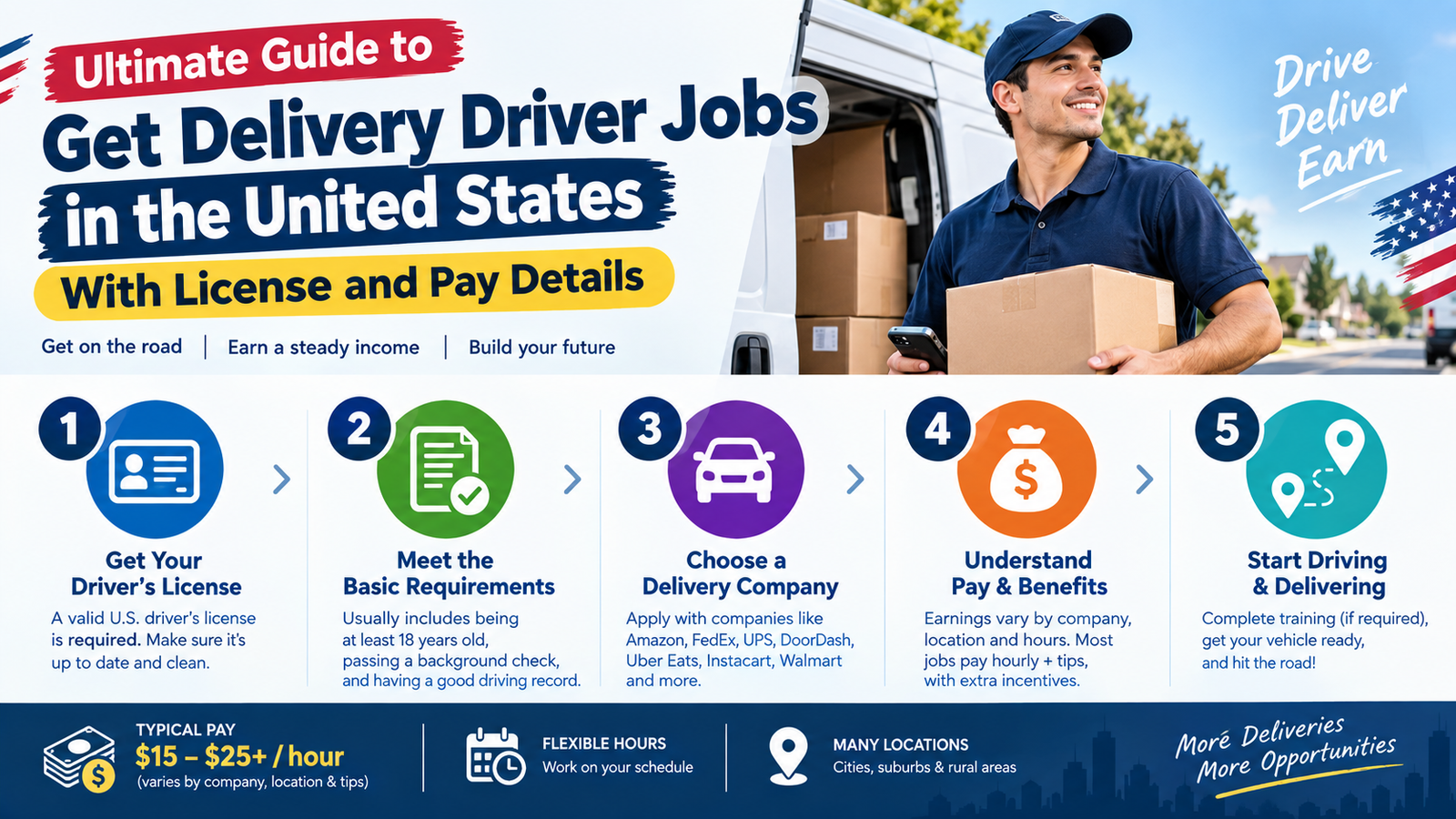
  • Ultimate Guide to Get Delivery Driver Jobs in the United States With License and Pay Details

    Ultimate Guide to Get Delivery Driver Jobs in the United States With License and Pay Details

    Delivery driver jobs are an important part of the U.S. transportation and logistics industry. As online shopping, food delivery, grocery services, pharmacies, and local businesses continue to rely on delivery networks, drivers are needed to transport packages and products to homes, businesses, and other locations.

    For people looking for driving-based employment, delivery driver positions can offer opportunities with different schedules and vehicle requirements. Some jobs involve delivering packages using a company vehicle, while others may require drivers to use their own car.

    This guide explains how to get delivery driver jobs in the United States, what type of license you may need, how much delivery drivers can earn, where to find jobs, and what international workers should know about work authorization.

    What Does a Delivery Driver Do?

    A delivery driver transports goods from a business, warehouse, restaurant, distribution center, or other location to customers.

    Typical responsibilities include:

    • Picking up packages or products
    • Loading and organizing deliveries
    • Driving safely to delivery locations
    • Following GPS directions
    • Delivering orders to customers
    • Obtaining delivery confirmation
    • Maintaining delivery records
    • Communicating with customers
    • Inspecting the vehicle
    • Following company safety procedures

    The exact responsibilities depend on the employer and type of delivery job.

    Types of Delivery Driver Jobs in the USA

    There are several types of delivery driving positions.

    Package Delivery Driver

    Package drivers deliver parcels from warehouses or distribution centers to residential and business addresses.

    These jobs may involve making many deliveries during a single shift.

    Food Delivery Driver

    Food delivery drivers transport meals from restaurants to customers.

    Depending on the company, drivers may use their own car, motorcycle, bicycle, or another approved vehicle.

    Grocery Delivery Driver

    Grocery delivery workers collect orders from supermarkets or distribution centers and deliver them to customers.

    Medical Delivery Driver

    Medical courier jobs can involve transporting prescriptions, medical supplies, laboratory specimens, or other healthcare-related materials. Additional procedures may apply depending on the employer and type of delivery.

    Local Delivery Driver

    Local businesses may hire drivers to deliver furniture, appliances, parts, supplies, or other products within a specific area.

    What License Do You Need?

    For many standard delivery jobs involving a regular passenger vehicle or light delivery vehicle, a valid state-issued driver’s license may be sufficient.

    However, the required license depends on the vehicle and job.

    A Commercial Driver’s License (CDL) may be required when the vehicle or operation falls under applicable commercial motor vehicle rules.

    The Federal Motor Carrier Safety Administration (FMCSA) explains that commercial driver’s license requirements depend on the type and weight of vehicle and other factors.

    Before applying, check the employer’s job description and determine whether the position requires:

    • Standard driver’s license
    • Clean or acceptable driving record
    • Minimum driving experience
    • CDL
    • Medical certification
    • Background check
    • Drug and alcohol testing where applicable

    Basic Requirements for Delivery Drivers

    Requirements vary by employer, but common qualifications include:

    • Valid driver’s license
    • Safe driving record
    • Reliable transportation when required
    • Ability to use GPS or navigation apps
    • Customer-service skills
    • Ability to lift packages when required
    • Good communication
    • Ability to work independently
    • Ability to follow delivery schedules

    Some employers may also require applicants to meet a minimum age requirement.

    Delivery Driver Pay in the United States

    Delivery driver earnings vary based on the occupation, employer, location, experience, schedule, tips, and type of vehicle.

    According to the U.S. Bureau of Labor Statistics, light truck drivers had a median annual wage of $47,950 in May 2025. The occupation includes drivers who transport goods using light trucks and similar vehicles.

    Pay can be structured in different ways. Some employees receive an hourly wage, while others may receive a salary, per-delivery compensation, mileage reimbursement, tips, bonuses, or a combination.

    Food and app-based delivery earnings can be particularly variable because income may depend on the number of deliveries, customer tips, location, working hours, and expenses such as fuel and vehicle maintenance.

    How to Find Delivery Driver Jobs

    Search Online Job Websites

    Use keywords such as:

    • Delivery driver jobs USA
    • Delivery driver jobs near me
    • Package delivery driver
    • Local delivery driver
    • Food delivery driver
    • Grocery delivery driver
    • Driver jobs with no experience
    • Delivery driver hiring

    Filter results according to your city, state, schedule, and license type.

    Apply Directly to Companies

    Many logistics, retail, grocery, restaurant, and delivery companies publish driver positions on their own career websites.

    Check whether the position is:

    • Full-time
    • Part-time
    • Seasonal
    • Contract
    • Employee-based
    • Independent contractor

    The employment arrangement can significantly affect pay, benefits, taxes, and vehicle expenses.

    How to Create a Delivery Driver Resume

    A delivery driver resume should highlight safe driving and reliability.

    Include:

    Professional Summary: Briefly explain your driving and delivery experience.

    Work Experience: Include previous driving, transportation, warehouse, logistics, customer-service, or delivery positions.

    License: Clearly state the type of driver’s license you hold.

    Skills: Mention:

    • Safe driving
    • GPS navigation
    • Route planning
    • Customer service
    • Package handling
    • Time management
    • Vehicle inspection
    • Communication

    If you have a CDL or other relevant certification, include it prominently.

    Can You Get a Delivery Driver Job Without Experience?

    Some entry-level delivery positions may accept applicants without previous professional delivery experience.

    However, you will generally need to meet the employer’s driving requirements and have the appropriate license.

    Experience in customer service, warehouse operations, transportation, or driving can strengthen your application.

    If you are new to the industry, consider applying for positions where the employer provides job-specific training.

    Work Schedule for Delivery Drivers

    Delivery schedules vary considerably.

    Drivers may work:

    • Morning shifts
    • Afternoon shifts
    • Evening shifts
    • Weekends
    • Holidays
    • Full-time schedules
    • Part-time schedules
    • Seasonal schedules

    Some delivery jobs involve strict delivery windows, while others offer more flexible schedules.

    Before accepting a position, ask about working hours, overtime, mileage, breaks, and delivery targets.

    Can Foreign Workers Get Delivery Driver Jobs in the USA?

    International applicants must have appropriate legal authorization to work in the United States.

    A foreign national cannot simply enter the country as a visitor and begin working as a delivery driver.

    Whether an international applicant can legally work depends on their immigration status or employment authorization.

    Applicants should also consider state driver’s-license requirements. A foreign driver’s license may not automatically be sufficient for long-term employment, and the rules for obtaining a U.S. driver’s license vary by state.

    If a job advertisement promises guaranteed U.S. visa sponsorship for a basic delivery-driver position, research the claim carefully before paying any money.

    How to Avoid Delivery Job Scams

    Be cautious about recruiters who promise:

    • Guaranteed U.S. jobs
    • Guaranteed visas
    • Extremely high salaries
    • Employment without an interview
    • Jobs in exchange for large upfront payments

    Verify the company, job location, salary, employment arrangement, and immigration information independently.

    Never assume that paying a recruiter guarantees a U.S. work visa.

    Step-by-Step Plan to Get a Delivery Driver Job

    Follow these steps:

    Step 1: Check that you have the required driver’s license.

    Step 2: Review your driving record and make sure you meet employer requirements.

    Step 3: Prepare a professional resume.

    Step 4: Search delivery and driver positions in your target location.

    Step 5: Apply directly through reputable job websites or company career pages.

    Step 6: Prepare for a driving and customer-service interview.

    Step 7: Confirm pay, schedule, vehicle requirements, and employment status.

    Step 8: Complete any required background checks or driving checks.

    Step 9: Complete employer training.

    Step 10: Begin work only after confirming that you have the required legal work authorization.

    Frequently Asked Questions

    Do delivery drivers need a CDL?

    Not always. Many light delivery jobs can be performed with a regular driver’s license. CDL requirements depend on the vehicle and applicable regulations.

    How much do delivery drivers make in the USA?

    Pay varies considerably. The BLS reported a $47,950 median annual wage for light truck drivers in May 2025, but individual delivery jobs may pay differently depending on the employer and compensation structure.

    Can I get a delivery driver job without experience?

    Yes, some employers hire entry-level drivers. However, you will generally need an appropriate driver’s license and must satisfy the employer’s driving requirements.

    Can foreigners work as delivery drivers in the USA?

    Only if they have valid U.S. work authorization that permits the employment. Immigration status and state driver’s-license requirements should be checked before accepting a job.

    Can I use my own car for delivery work?

    Some companies and delivery platforms allow drivers to use their own vehicles, while others provide company vehicles. Always check the specific job’s requirements, insurance arrangements, and vehicle expenses.

    Final Thoughts

    Delivery driving can be a practical career option for people who enjoy driving, working independently, and interacting with customers. Opportunities exist in package delivery, food delivery, grocery delivery, medical courier services, and local business transportation.

    The first step is to determine which type of delivery job you want and whether you have the appropriate driver’s license. Standard light-vehicle delivery jobs generally have different requirements from commercial truck-driving positions that may require a CDL.

    Pay also varies widely depending on the employer, location, schedule, tips, bonuses, and employment arrangement. Before accepting an offer, make sure you understand the total compensation and any expenses you are responsible for.

    For international applicants, legal work authorization is essential. A driver’s license alone does not provide permission to work in the United States.

    By preparing a strong resume, maintaining a safe driving record, searching reputable employers, and carefully checking job and immigration requirements, you can approach the U.S. delivery-driver job market with a clear and practical plan.

    Disclaimer: This article is for general informational purposes only and is not legal, immigration, employment, or financial advice. Driver licensing, commercial driving, employment, and immigration requirements can vary by state and individual circumstances. Always verify current requirements with the relevant state agency, employer, FMCSA, USCIS, or other official sources.

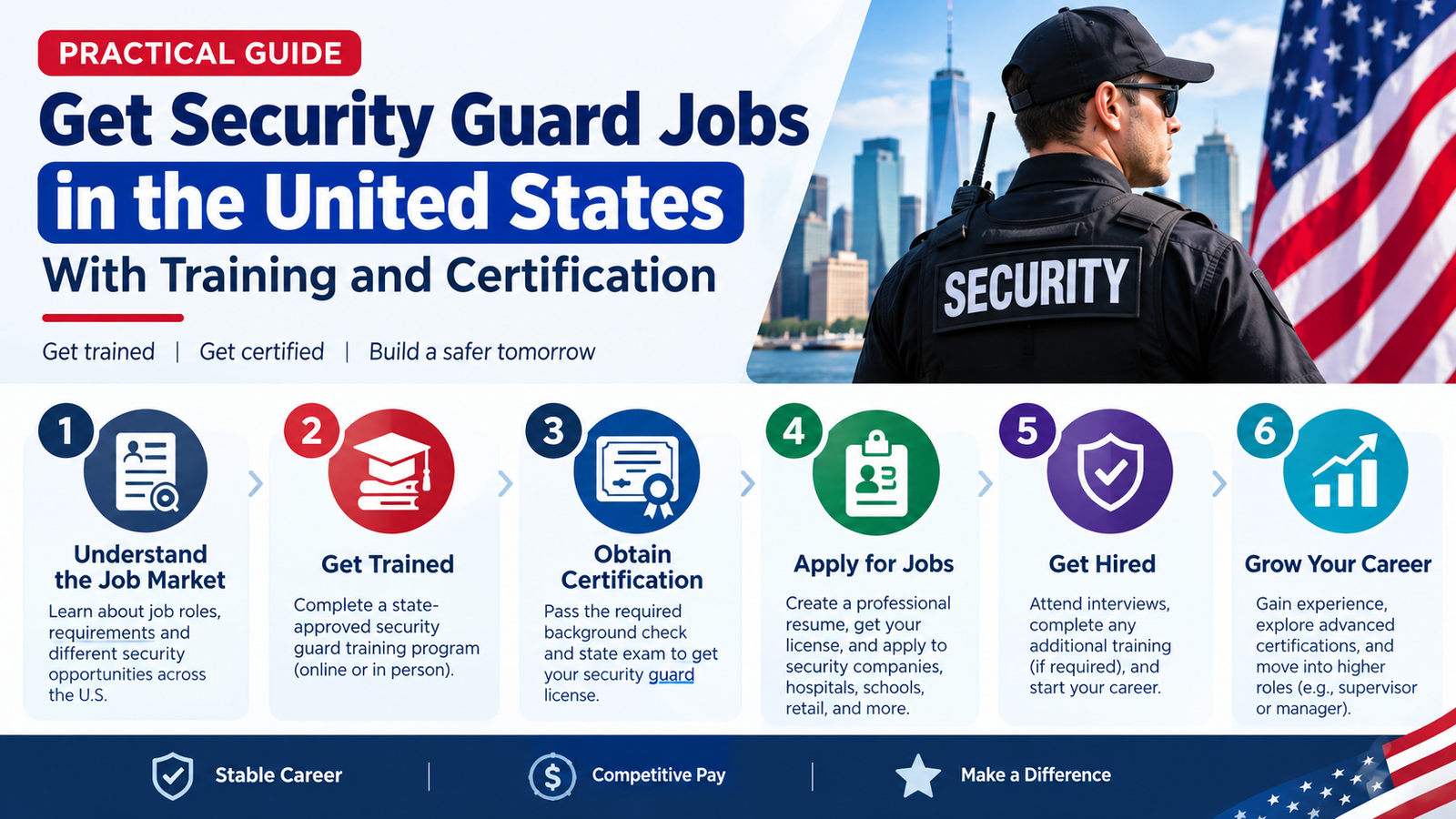
  • Practical Guide to Get Security Guard Jobs in the United States With Training and Certification

    Practical Guide to Get Security Guard Jobs in the United States With Training and Certification

    Security guard jobs are an important part of the private security industry in the United States. Security professionals work in office buildings, shopping centers, hotels, hospitals, residential communities, warehouses, construction sites, educational institutions, and many other locations.

    For people looking for a career that does not always require a college degree, security work can be an option worth exploring. However, requirements are not identical across the United States. Security guards are generally regulated at the state level, and applicants may need to complete background checks, training, licensing, registration, or certification depending on where they want to work.

    This guide explains how to become a security guard in the United States, what training and certifications may be required, how to find jobs, what employers look for, salary information, and what international applicants should know about work authorization.

    Important: Security-guard licensing requirements vary by state and sometimes by job type. Always check the current requirements of the state licensing authority before paying for training or accepting a position.

    What Does a Security Guard Do?

    Security guards help protect people, property, buildings, and businesses. Their exact duties depend on the employer and assignment.

    Common responsibilities include:

    • Monitoring entrances and exits
    • Checking identification
    • Patrolling buildings and property
    • Monitoring security cameras
    • Writing incident reports
    • Responding to alarms
    • Preventing unauthorized access
    • Protecting property
    • Assisting during emergencies
    • Reporting suspicious activity
    • Enforcing site-specific security procedures

    Security guards may work independently or as part of a larger security team.

    Some positions are primarily focused on observation and reporting, while others involve access control, patrols, customer service, or specialized security responsibilities.

    Types of Security Guard Jobs in the USA

    There are many different security positions available.

    Unarmed Security Guard

    Unarmed guards generally protect property and people without carrying a firearm as part of their job.

    Typical assignments include:

    • Office buildings
    • Retail stores
    • Residential communities
    • Hotels
    • Warehouses
    • Construction sites
    • Hospitals

    These positions can be suitable for people entering the private security industry.

    Armed Security Guard

    Armed security positions involve additional requirements because the employee carries a firearm while performing security duties.

    Depending on the state, an applicant may need additional firearms training, licensing, background checks, and authorization.

    Armed security jobs should not be treated as ordinary entry-level security positions because the legal and training requirements can be significantly different.

    Corporate Security

    Corporate security guards or officers may work in office buildings and corporate facilities.

    Their responsibilities can include access control, visitor management, patrols, emergency response, and security monitoring.

    Hospital Security

    Healthcare facilities employ security personnel to help maintain a safe environment for patients, visitors, and employees.

    Hospital security can involve dealing with difficult situations, monitoring entrances, responding to incidents, and working closely with healthcare staff.

    Event Security

    Event security personnel can work at:

    • Concerts
    • Sports events
    • Conferences
    • Festivals
    • Large public gatherings

    Their responsibilities may include crowd monitoring, access control, ticket-area security, and assisting with emergency procedures.

    Security Guard Requirements in the United States

    There is no single nationwide security-guard license that applies to every private security worker.

    Requirements are primarily determined by state law.

    Depending on the state and position, applicants may need to meet requirements involving:

    • Minimum age
    • Identification
    • Background checks
    • Fingerprinting
    • Training
    • Licensing or registration
    • Criminal-history requirements
    • Employment eligibility
    • Additional qualifications for armed positions

    Some states have detailed training requirements, while others have different licensing structures.

    Therefore, the first step should be identifying where you want to work.

    Step 1: Choose Your State

    Before enrolling in a security-guard training course, determine which state you intend to work in.

    Search for the official state agency responsible for regulating private security.

    For example, requirements can differ between California, Texas, Florida, New York, Illinois, and other states.

    Do not assume that a security license from one state automatically allows you to work in another state.

    Some employers may also have additional requirements beyond the minimum state licensing standards.

    Step 2: Check the Minimum Age Requirement

    Many states require security guards to meet a minimum age requirement.

    The exact age depends on the state and sometimes on the type of security work.

    Armed security positions can have additional age and licensing requirements.

    Check the applicable state rules before applying.

    Step 3: Complete Required Training

    Training is an important part of becoming a security guard.

    Depending on the state, training may cover subjects such as:

    • Security officer responsibilities
    • Legal powers and limitations
    • Ethics
    • Communication
    • Emergency procedures
    • Report writing
    • Access control
    • Patrol procedures
    • Observation skills
    • Workplace safety
    • Conflict management
    • First aid or CPR
    • Use-of-force laws

    The required number of training hours can vary considerably.

    Some states require training before employment, while others allow an employer to provide certain training after hiring.

    Security Guard Certification and Licensing

    The words certification, registration, and license can have different meanings depending on the state.

    In some locations, a security guard must obtain a state registration or license. In others, an employer may have specific certification requirements.

    You should always determine:

    1. Which government agency regulates security guards in your state?
    2. Is a license or registration required?
    3. What training is mandatory?
    4. Is fingerprinting required?
    5. Is a background check required?
    6. Does the employer require additional certification?

    This prevents you from paying for a course that does not satisfy your state’s requirements.

    First Aid and CPR Certification

    First aid and CPR training can be useful for security professionals.

    Security officers may be among the first employees to respond when someone becomes injured or experiences a medical emergency.

    Some employers require or prefer first aid and CPR certification, especially for security positions in:

    • Schools
    • Hospitals
    • Residential communities
    • Large facilities
    • Public venues

    Even where certification is not legally required, relevant training can strengthen a candidate’s resume.

    Skills Employers Look For

    A successful security guard needs more than physical strength.

    Important skills include:

    Communication

    Security guards regularly communicate with employees, visitors, customers, supervisors, law enforcement, and emergency personnel.

    Observation

    Security work requires paying attention to unusual behavior, access issues, safety concerns, and potential security problems.

    Report Writing

    Security officers frequently document incidents, observations, and daily activities.

    Clear and accurate writing is therefore important.

    Professionalism

    Security personnel often represent the company or client at the location where they work.

    Professional behavior and appearance can be important.

    Conflict Management

    Security guards may encounter disagreements or difficult situations.

    The ability to remain calm, communicate clearly, and follow established procedures is valuable.

    Reliability

    Security operations depend heavily on employees arriving on time and completing assigned shifts.

    Employers may place significant importance on attendance and reliability.

    Do You Need Previous Experience?

    Not always.

    Some entry-level security jobs provide training to new employees.

    However, previous experience in areas such as:

    • Customer service
    • Military service
    • Law enforcement
    • Hospitality
    • Retail
    • Safety
    • Emergency response

    may be useful depending on the position.

    Specialized security jobs can require additional experience or qualifications.

    Security Guard Salary in the United States

    Security guard compensation varies by state, employer, experience, assignment, and schedule.

    According to the U.S. Bureau of Labor Statistics, the median annual wage for security guards was $38,370 in May 2025. The BLS reports that the lowest 10 percent earned less than $30,390, while the highest 10 percent earned more than $59,400. (bls.gov)

    The BLS also projects approximately 162,300 openings for security guards each year on average from 2024 to 2034, primarily due to workers leaving the occupation and needing replacement. (bls.gov)

    Actual wages can differ substantially based on location and assignment.

    For example, specialized security positions, overnight shifts, supervisory jobs, and assignments in higher-cost areas may have different compensation.

    Where Security Guards Work

    Security guards work across many industries.

    Common workplaces include:

    • Office buildings
    • Retail stores
    • Shopping centers
    • Hospitals
    • Hotels
    • Schools
    • Universities
    • Warehouses
    • Manufacturing facilities
    • Construction sites
    • Residential communities
    • Airports
    • Government facilities
    • Entertainment venues

    The requirements and responsibilities can differ considerably between locations.

    How to Find Security Guard Jobs in the USA

    Search Online Job Platforms

    Use search terms such as:

    • Security guard jobs USA
    • Security officer jobs
    • Unarmed security jobs
    • Security jobs near me
    • Entry-level security jobs
    • Security officer hiring
    • Security guard jobs no experience

    Filter results by state and city.

    Apply Directly to Security Companies

    Many private security companies recruit employees through their own websites.

    Look for career pages containing terms such as:

    • Security Officer
    • Security Guard
    • Patrol Officer
    • Site Security Officer
    • Security Specialist

    Read the job requirements carefully before applying.

    Search Individual Employers

    Hospitals, hotels, universities, warehouses, shopping centers, and manufacturing companies may advertise security positions directly.

    Some large organizations use in-house security departments, while others hire private security contractors.

    How to Prepare a Security Guard Resume

    Your resume should be simple and professional.

    Include:

    Professional Summary: Briefly describe your security, customer-service, military, or related experience.

    Work Experience: List previous employers, job titles, dates, and responsibilities.

    Certifications: Include relevant security training, CPR, first aid, or other certifications.

    Skills: Mention observation, communication, report writing, access control, conflict management, and computer skills.

    Education: List relevant educational qualifications.

    If you have no previous security experience, emphasize transferable skills from retail, hospitality, customer service, military, or other jobs.

    How to Prepare for a Security Guard Interview

    Security interviews may include questions about difficult situations.

    For example:

    “What would you do if you saw suspicious activity?”

    A good response should focus on following company procedures, maintaining personal and public safety, documenting the incident, and contacting the appropriate supervisor or emergency service when required.

    “How would you handle an angry visitor?”

    Explain that you would remain calm, communicate professionally, avoid unnecessary confrontation, and follow site procedures.

    “Can you work overnight or weekends?”

    Security operations often run around the clock. Be honest about your availability.

    Work Schedules for Security Guards

    Security facilities frequently operate 24 hours a day.

    Security guards may therefore work:

    • Morning shifts
    • Afternoon shifts
    • Overnight shifts
    • Weekends
    • Holidays
    • Rotating schedules

    The BLS notes that security guards often work around the clock, including nights, weekends, and holidays. (bls.gov)

    Before accepting a job, confirm the expected schedule and whether overtime is available.

    Can Foreign Workers Get Security Guard Jobs in the USA?

    International applicants need to understand that obtaining a security guard position is not the same as obtaining authorization to work in the United States.

    A foreign national generally needs an appropriate immigration status or employment authorization that permits the specific employment.

    Security guard positions also involve state-specific licensing and background requirements.

    Because of these factors, international applicants should first determine whether they have legal authorization to work in the United States and whether they satisfy the security licensing requirements of the state where they want to work.

    A job offer by itself does not automatically provide U.S. work authorization.

    Security Guard Jobs and Visa Sponsorship

    Applicants should be particularly careful about advertisements claiming to provide “guaranteed security guard visa sponsorship.”

    There is no general U.S. visa that automatically applies simply because someone wants to work as a security guard.

    Temporary employment categories have specific eligibility requirements, and an employer must satisfy the requirements of the relevant immigration program.

    If an employer claims that it can sponsor you, ask for detailed written information about:

    • Employer identity
    • Job location
    • Job title
    • Salary
    • Contract period
    • Visa category
    • Immigration process
    • Recruitment fees
    • Employment conditions

    Verify the information independently before paying money or signing a contract.

    How to Avoid Security Job Scams

    International job seekers should be cautious about fake security recruitment agencies.

    Warning signs include:

    • Guaranteed visa approval
    • Guaranteed permanent residency
    • Extremely high salaries for entry-level work
    • Requests for large upfront payments
    • No interview
    • No written contract
    • Requests for payment through personal accounts
    • Unofficial email addresses
    • Pressure to make immediate payments

    Never assume that a recruiter can guarantee immigration approval.

    Research the employer and verify immigration information through official U.S. government sources.

    Step-by-Step Plan to Become a Security Guard

    If you want to start a security career in the United States, follow this general process:

    Step 1: Choose the state where you want to work.

    Step 2: Find the official state security-licensing authority.

    Step 3: Check age, background, training, and licensing requirements.

    Step 4: Complete any required security training.

    Step 5: Complete fingerprinting or background checks if required.

    Step 6: Obtain the required registration or license.

    Step 7: Prepare your resume.

    Step 8: Apply to security companies and employers.

    Step 9: Complete interviews and employer-specific training.

    Step 10: Maintain your license and required certifications.

    Frequently Asked Questions

    Do you need a degree to become a security guard?

    Generally, a college degree is not required for entry-level security guard positions. Requirements vary by state and employer.

    Do security guards need certification?

    Requirements vary by state. Some states require registration, licensing, or specific training. Employers may also require additional certifications.

    How much does a security guard make in the USA?

    The BLS reported a median annual wage of $38,370 in May 2025. Actual pay depends on location, employer, experience, assignment, and schedule. (bls.gov)

    Can I become a security guard without experience?

    Yes. Some employers hire entry-level applicants and provide training. Previous customer-service, military, safety, or related experience can be helpful.

    Do armed guards need additional training?

    Typically, armed security positions have additional requirements involving firearms training and authorization. The exact requirements depend on state law and the employer.

    Can foreigners get security guard jobs in the United States?

    Foreign nationals may work in the United States only when they have appropriate work authorization or immigration status. They must also satisfy applicable state security requirements.

    Are security guard jobs available at night?

    Yes. Many security operations run 24 hours a day, so overnight and weekend positions are common. (bls.gov)

    Final Thoughts

    Security guard work can provide an entry point into the private security industry without necessarily requiring a college degree. However, applicants need to understand that security licensing and training requirements differ from state to state.

    The best starting point is to decide where you want to work and then check the requirements of the relevant state licensing authority. After completing required training and background procedures, you can begin applying to security companies, businesses, hospitals, hotels, residential communities, warehouses, and other employers.

    Developing strong communication, observation, report-writing, customer-service, and conflict-management skills can make your application more competitive. Additional training such as first aid or CPR may also be useful depending on the position.

    For international applicants, work authorization is a separate issue from professional qualification. Before accepting a U.S. security job, verify that you are legally authorized to work and that you meet the licensing requirements for the state and position.

    Finally, be careful with recruitment agencies that promise guaranteed U.S. jobs or visas. Verify employers, contracts, training requirements, and immigration information before paying any fees.

    With proper training, the appropriate state credentials, a professional resume, and a consistent job-search strategy, candidates can approach the U.S. security employment market in a more informed and organized way.

    Disclaimer: This article is for general informational purposes only and is not legal, immigration, employment, or security-training advice. Licensing, training, work-authorization, and immigration requirements can change and vary by state and individual circumstances. Always verify current requirements with the relevant state authority and official U.S. government sources.

  • Complete Guide to Get Retail Store Jobs in the United States for Cashiers and Sales Staff

    Complete Guide to Get Retail Store Jobs in the United States for Cashiers and Sales Staff

    Retail stores are an important part of the U.S. economy and employ millions of people in supermarkets, department stores, clothing shops, electronics stores, pharmacies, furniture stores, home-improvement stores, convenience stores, and other businesses.

    For people looking for entry-level or customer-facing employment, cashier and retail sales positions can be an accessible way to enter the retail industry. Many of these jobs do not require a college degree, although employers may look for customer-service skills, reliability, communication abilities, basic computer knowledge, and previous retail experience.

    For international job seekers, however, finding a retail job in the United States involves an additional consideration: legal authorization to work in the country. A person cannot simply travel to the United States and start working without the appropriate employment authorization or immigration status.

    This guide explains how to find cashier and retail sales jobs in the United States, what qualifications employers commonly look for, expected pay, how to apply, and what international applicants should know about work authorization.

    What Are Retail Store Jobs?

    Retail store jobs involve helping customers, selling products, processing payments, maintaining merchandise, stocking shelves, and supporting day-to-day store operations.

    Common retail positions include:

    • Cashier
    • Retail Sales Associate
    • Store Associate
    • Customer Service Associate
    • Stock Clerk
    • Merchandising Associate
    • Parts Salesperson
    • Department Associate
    • Store Supervisor
    • Assistant Store Manager
    • Store Manager

    The exact responsibilities depend on the employer and position.

    Cashiers primarily process customer purchases and payments, while retail sales workers spend more time helping customers select products and completing sales.

    According to the U.S. Bureau of Labor Statistics (BLS), cashiers held approximately 3.1 million jobs in 2025, while retail salespersons held approximately 4.0 million jobs.

    How to Get a Cashier Job in the United States

    Cashier positions are often considered entry-level retail jobs.

    The BLS reports that cashiers typically have no formal educational credential requirement and generally receive short-term on-the-job training.

    However, having the right skills can make your application stronger.

    Important Cashier Skills

    Employers may look for:

    • Customer service
    • Basic mathematics
    • Cash handling
    • Attention to detail
    • Communication
    • Point-of-sale system knowledge
    • Ability to work under pressure
    • Reliability
    • Teamwork
    • Physical stamina

    Cashiers must accurately process transactions and may also handle returns, exchanges, coupons, gift cards, and other customer requests.

    Because many cashier positions require workers to stand for extended periods, physical stamina can also be important.

    How to Get a Retail Sales Job

    Retail sales workers help customers find products, answer questions, explain product features, and complete purchases.

    The BLS states that retail sales workers typically do not need formal education to enter the occupation, although some employers prefer candidates with a high school diploma or equivalent. Most workers learn their responsibilities through on-the-job training.

    Skills for Retail Sales Staff

    Useful skills include:

    • Customer service
    • Communication
    • Product knowledge
    • Sales skills
    • Problem-solving
    • Listening
    • Teamwork
    • Basic computer skills
    • Inventory awareness
    • Ability to work toward sales goals

    Previous experience in retail, hospitality, customer service, or sales can also be useful.

    Types of Retail Stores Hiring Workers

    Retail employees can work in many different types of businesses.

    Grocery Stores

    Grocery stores commonly hire:

    • Cashiers
    • Stock associates
    • Customer service associates
    • Department workers
    • Bakery and deli staff

    Clothing Stores

    Clothing retailers may hire:

    • Sales associates
    • Cashiers
    • Fitting-room associates
    • Stock associates
    • Visual merchandising staff

    Electronics Stores

    Electronics retailers may look for sales workers who can explain products and help customers compare different options.

    Home Improvement Stores

    These businesses can employ sales associates, cashiers, stock workers, and specialized department employees.

    Furniture Stores

    Furniture sales positions can involve explaining products, assisting customers, preparing orders, and completing sales.

    Convenience and Specialty Stores

    Convenience stores, pharmacies, sporting-goods stores, beauty stores, and specialty retailers also employ customer-facing workers.

    Retail Job Requirements in the United States

    Requirements vary by employer and position.

    For entry-level cashier and retail sales positions, common requirements may include:

    • Minimum legal working age
    • Ability to communicate with customers
    • Basic mathematics
    • Ability to work assigned shifts
    • Customer-service skills
    • Reliable attendance
    • Ability to stand for extended periods
    • Ability to lift or move merchandise when required

    Some employers may require a high school diploma or equivalent, while others may not.

    More advanced positions such as department supervisor or store manager generally require relevant work experience.

    Salary for Cashiers and Retail Sales Workers

    Pay varies according to location, employer, experience, working hours, and position.

    According to the BLS, the median hourly wage for cashiers was $15.81 in May 2025, equivalent to approximately $32,880 annually when expressed as the BLS median annual wage.

    For retail salespersons, the BLS reported a median hourly wage of $17.03 in May 2025, with a median annual wage of approximately $35,410 in the broader occupational data.

    Actual earnings can be higher or lower depending on the job.

    Factors that can affect compensation include:

    • State
    • City
    • Employer
    • Previous experience
    • Full-time or part-time status
    • Shift
    • Commission
    • Sales incentives
    • Overtime
    • Position level

    Some retail sales positions may also include commissions or bonuses.

    Retail Job Outlook in the United States

    The retail industry continues to provide a large number of employment opportunities, but the outlook differs between occupations.

    The BLS projects cashier employment to decline 6% from 2025 to 2035. Despite the projected decline, approximately 521,300 cashier openings per year are expected on average during the decade, largely because employers need to replace workers who leave the occupation.

    For retail sales workers overall, employment is projected to show little or no change from 2025 to 2035, with approximately 550,600 openings per year expected on average.

    Technology, self-checkout systems, and increasing online shopping are influencing the number and type of traditional retail positions available. At the same time, physical stores continue to require employees to assist customers and perform a variety of customer-service tasks.

    How to Find Retail Jobs in the USA

    There are several ways to search for retail employment.

    1. Company Career Websites

    Many retailers publish job openings directly on their websites.

    Search for sections such as:

    • Careers
    • Jobs
    • Employment
    • Store Jobs
    • Retail Careers
    • Hourly Jobs

    Applying directly can help you find current openings at specific stores.

    2. Online Job Websites

    Search for terms such as:

    • Cashier jobs USA
    • Retail sales associate jobs
    • Retail jobs near me
    • Store associate jobs
    • Customer service retail jobs
    • Part-time retail jobs
    • Full-time retail jobs

    You can also filter results by location and employment type.

    3. Apply In Person

    Some local retailers accept applications at physical stores.

    If you apply in person, bring a professional resume and dress appropriately. Be prepared to briefly explain your experience and availability.

    4. Networking

    Tell friends, former colleagues, and professional contacts that you are looking for retail employment.

    Retail businesses frequently hire for multiple shifts and may have openings that are not widely advertised.

    How to Create a Retail Resume

    A retail resume does not need to be extremely long.

    For an entry-level position, a one-page resume can be sufficient.

    Include:

    Contact Information

    Add your name, phone number, email address, and general location.

    Professional Summary

    Write two or three sentences describing your customer-service or retail experience.

    Work Experience

    Include:

    • Employer
    • Job title
    • Dates of employment
    • Main responsibilities
    • Achievements

    Skills

    Examples include:

    • Customer service
    • Cash handling
    • POS systems
    • Inventory management
    • Sales
    • Communication
    • Teamwork
    • Problem-solving

    Education

    Include your highest relevant educational qualification.

    How to Prepare for a Retail Job Interview

    Retail interviews often focus on customer service and workplace situations.

    You may be asked questions such as:

    “How would you handle an angry customer?”

    Explain that you would remain calm, listen carefully, understand the customer’s concern, and follow store policies to find an appropriate solution.

    “Why do you want to work here?”

    Research the company before the interview and explain why the position matches your skills and career goals.

    “Can you work weekends?”

    Retail businesses often operate on weekends, evenings, and holidays, so be honest about your availability.

    “Do you have cash-handling experience?”

    If you have previous experience, explain the type of transactions and systems you handled.

    If you do not have experience, emphasize your attention to detail, willingness to learn, and ability to follow procedures.

    Full-Time vs. Part-Time Retail Jobs

    Retail businesses offer both full-time and part-time opportunities.

    Part-time positions can be useful for people who:

    • Are studying
    • Need flexible schedules
    • Are starting their first job
    • Want additional income

    Full-time positions may provide more consistent working hours and may include employer benefits depending on the company.

    The BLS notes that cashier schedules can include early mornings, evenings, weekends, and holidays, while retail sales workers may also work evenings and weekends.

    Can Foreign Workers Get Retail Jobs in the United States?

    International applicants need to understand an important point: a job offer does not automatically give someone permission to work in the United States.

    A foreign national generally needs an appropriate immigration status or employment authorization that permits the specific employment.

    Retail cashier and general sales positions are not automatically eligible for common professional work-visa categories simply because an employer has a vacancy.

    For this reason, international applicants should check whether their existing U.S. immigration status permits employment or whether a specific employment-based pathway could apply.

    H-2B and Temporary Retail-Related Employment

    The H-2B program is a temporary nonagricultural worker program. It may apply to certain temporary jobs when an employer meets the program’s requirements.

    However, applicants should not assume that an ordinary permanent retail-store job qualifies for H-2B classification.

    Eligibility depends on factors including the temporary nature of the employment, employer requirements, nationality rules, and applicable government procedures.

    If you are outside the United States and specifically need visa sponsorship, research the immigration category before accepting or paying for a job opportunity.

    What International Applicants Should Check

    If you need U.S. work authorization, ask an employer or recruiter clear questions before proceeding.

    For example:

    • Does the company hire workers who require employment sponsorship?
    • Does this particular position qualify for sponsorship?
    • What type of work authorization is involved?
    • Is the position temporary or permanent?
    • Who is responsible for the immigration process?
    • Are there recruitment or legal fees?
    • What are the employment conditions?

    Never assume that a company offering a retail position automatically provides visa sponsorship.

    Avoid Retail Job Scams

    International job seekers can be particularly vulnerable to fake employment offers.

    Be careful if someone promises:

    • Guaranteed U.S. employment
    • Guaranteed visa approval
    • Guaranteed permanent residency
    • Extremely high wages for simple retail work
    • A job without an interview
    • A visa after paying a large upfront fee

    Before sending money or personal documents, independently verify the employer.

    Do not rely solely on WhatsApp messages, social-media profiles, or unofficial recruitment agents.

    Ask for a written job offer containing details such as:

    • Employer name
    • Job title
    • Location
    • Salary or hourly wage
    • Working hours
    • Responsibilities
    • Benefits
    • Contract period

    Tips for Getting a Retail Job Faster

    You can improve your job search by following a consistent strategy.

    Apply to Multiple Positions

    Do not depend on one application. Apply to several suitable jobs each week.

    Customize Your Resume

    Highlight cashier experience when applying for cashier positions and sales achievements when applying for sales jobs.

    Improve Customer-Service Skills

    Practice communication, listening, problem-solving, and product-presentation skills.

    Learn POS Systems

    Familiarity with point-of-sale systems can be useful for cashier and retail positions.

    Be Flexible With Shifts

    If your schedule allows, being available for evenings, weekends, or holiday periods can increase the number of positions you can consider.

    Prepare for Interviews

    Practice answers to common customer-service and retail questions before meeting an employer.

    Step-by-Step Plan to Find a Retail Job in the USA

    Follow this simple process:

    Step 1: Choose the type of retail position you want.

    Step 2: Prepare a professional resume.

    Step 3: List your customer-service and sales skills.

    Step 4: Search company career websites and job platforms.

    Step 5: Apply for multiple suitable positions.

    Step 6: Follow up on applications when appropriate.

    Step 7: Prepare for interviews.

    Step 8: Confirm salary, schedule, duties, and employment conditions.

    Step 9: If you are an international applicant, verify your legal work authorization before accepting employment.

    Step 10: Complete the employer’s hiring and onboarding process.

    Frequently Asked Questions

    Do I need a college degree to become a cashier in the USA?

    Generally, no. The BLS states that cashiers typically have no formal educational credential requirement and receive short-term on-the-job training.

    Do retail sales jobs require a degree?

    Usually not for entry-level retail sales positions. The BLS reports that retail sales workers typically do not need formal education to enter the occupation, although some employers prefer a high school diploma or equivalent.

    How much do cashiers make in the USA?

    The BLS reported a median cashier wage of $15.81 per hour in May 2025. Actual wages vary by employer, location, experience, and other factors.

    How much do retail sales workers make?

    The BLS reported a median hourly wage of $17.03 for retail salespersons in May 2025. Compensation varies by position, location, employer, and experience.

    Can I get a U.S. retail job without experience?

    Yes. Many entry-level retail jobs provide on-the-job training. However, customer-service skills, reliability, communication, and a positive work attitude can make an application stronger.

    Can foreigners apply for U.S. retail jobs?

    Foreign nationals can apply for U.S. jobs, but they must have appropriate authorization to work in the United States. A job offer alone does not automatically provide work authorization.

    Are cashier jobs available in the United States?

    Yes. Although BLS projections show a decline in cashier employment through 2035, the occupation is still large and is projected to have approximately 521,300 openings per year on average, mainly because workers leave the occupation and need to be replaced.

    Final Thoughts

    Retail stores continue to employ millions of people across the United States. Cashiers, retail sales associates, stock workers, customer-service employees, and supervisors all contribute to store operations.

    Cashier positions can be accessible to people without formal college qualifications, while retail sales positions can provide opportunities for people with strong communication and customer-service skills.

    The current U.S. labor outlook shows that retail employment varies by occupation. Cashier employment is projected to decline as self-checkout and other technologies expand, while overall retail sales employment is projected to remain relatively stable. Even where employment growth is limited, the large size of the workforce means there are still many openings created by worker replacement.

    For international applicants, the most important issue is work authorization. Before accepting a U.S. retail position, make sure you understand whether you are legally authorized to work and whether the employer can support the immigration pathway you require.

    By preparing a strong resume, improving customer-service skills, applying consistently, researching employers, and verifying employment and immigration information carefully, job seekers can approach the U.S. retail job market in a more organized and informed way.

    Disclaimer: This article is for general informational purposes only. Salary figures and employment projections are based on U.S. Bureau of Labor Statistics information and can change. Immigration and work-authorization rules can also change. International applicants should verify current requirements through official U.S. government sources or seek advice from a qualified immigration professional for individual circumstances.

  • Updated Guide to Get Healthcare Jobs in the United States for Nurses and Medical Assistants

    Updated Guide to Get Healthcare Jobs in the United States for Nurses and Medical Assistants

    The healthcare industry in the United States provides employment opportunities for millions of professionals, including registered nurses, licensed practical nurses, nursing assistants, medical assistants, and other healthcare workers. For international professionals, working in the United States can be an attractive career option, but getting a healthcare job requires more than simply submitting a resume.

    Nurses generally need to satisfy U.S. state licensing requirements before practicing as nurses, while medical assistants have different education and certification requirements. International healthcare professionals may also need credential evaluations, English-language testing, examinations, and appropriate U.S. work authorization depending on their occupation and circumstances.

    This updated guide explains how nurses and medical assistants can search for healthcare jobs in the United States, understand the qualification process, prepare for employment, and learn about possible work-visa pathways.

    Important: U.S. healthcare licensing and immigration requirements vary by occupation, state, employer, and individual circumstances. Always verify current requirements with the relevant state licensing board, USCIS, U.S. Department of State, and other official organizations before making immigration or employment decisions.

    Healthcare Jobs in the United States

    Healthcare is one of the largest employment sectors in the United States. Hospitals, physician offices, outpatient facilities, nursing facilities, home healthcare organizations, and other healthcare providers employ professionals in a wide range of positions.

    Two occupations that attract significant interest are registered nurses (RNs) and medical assistants (MAs).

    According to the U.S. Bureau of Labor Statistics (BLS), registered nurses had about 3.47 million jobs in 2025, and employment is projected to grow by 6% from 2025 to 2035. The BLS projects approximately 180,800 openings per year for registered nurses over that period.

    Medical assistants had approximately 833,900 jobs in 2025, with employment projected to grow 13% from 2025 to 2035, considerably faster than the average for all occupations. The BLS projects approximately 109,700 medical-assistant openings per year during that period.

    These figures do not guarantee employment for an individual applicant, but they provide useful information about the overall U.S. employment outlook.

    How to Get a Nursing Job in the United States

    International nurses generally need to complete several steps before they can legally practice as nurses in the United States.

    1. Complete Nursing Education

    The first requirement is an appropriate nursing education.

    Registered nurses in the United States commonly enter the profession through:

    • A bachelor’s degree in nursing
    • An associate degree in nursing
    • A diploma from an approved nursing program

    Registered nurses must be licensed.

    Internationally educated nurses should have their academic and professional credentials reviewed according to the requirements of the state where they want to practice.

    2. Identify the State Where You Want to Work

    Nursing is regulated at the state level. This means requirements can differ from one state to another.

    Before applying for jobs, an international nurse should identify the state where they intend to work and review the requirements of that state’s nursing regulatory authority.

    Requirements may include:

    • Educational evaluation
    • Credential verification
    • English-language proficiency
    • Nursing examination
    • Background checks
    • Fingerprinting
    • State-specific documentation
    • Application fees

    Because requirements can change, candidates should always check the current instructions from the relevant state board of nursing.

    3. Pass the NCLEX-RN

    For candidates seeking registered-nurse licensure, the NCLEX-RN is an important part of the U.S. nursing licensure process.

    Internationally educated nurses should first determine whether they meet the eligibility requirements established by the nursing regulatory authority where they want to obtain licensure.

    Passing the NCLEX-RN does not by itself provide immigration status or automatically authorize employment. Licensing and immigration are separate processes.

    4. Complete Credential Evaluation

    International nurses may need to provide academic records and professional documents for evaluation.

    Organizations such as CGFNS International provide credential evaluation and related services for internationally educated healthcare professionals.

    The exact evaluation requirements depend on the state, occupation, employer, and immigration pathway.

    English-Language Requirements for International Nurses

    English proficiency may be part of the licensing or immigration process for internationally educated nurses.

    Depending on the applicable pathway, applicants may be asked to provide evidence through an approved English-language examination or another accepted method.

    Do not assume that one English test is accepted everywhere. Requirements can vary depending on the state board, licensing route, and immigration process.

    Before paying for an examination, check the current requirements for your specific pathway.

    VisaScreen for International Healthcare Professionals

    Some internationally educated healthcare professionals seeking certain occupational visas may need a VisaScreen: Visa Credentials Assessment.

    CGFNS states that VisaScreen is a comprehensive screening service for healthcare professionals seeking an occupational visa in the United States. The program covers certain healthcare professions, including registered nurses and licensed practical/vocational nurses.

    For registered nurses, CGFNS states that evidence of passing the NCLEX-RN or the CGFNS Qualifying Exam can satisfy the nursing knowledge examination component of VisaScreen.

    VisaScreen is a credential-screening process; it is not itself a U.S. work visa. Candidates should determine which immigration category applies to their circumstances.

    Nursing Jobs Available in the United States

    Nurses can work in many different healthcare environments.

    Examples include:

    • Hospitals
    • Emergency departments
    • Intensive care units
    • Outpatient clinics
    • Physician offices
    • Nursing facilities
    • Home healthcare
    • Schools
    • Rehabilitation facilities
    • Community healthcare
    • Specialty clinics

    Registered nurses can also specialize in areas such as:

    • Critical care
    • Oncology
    • Pediatrics
    • Cardiology
    • Emergency nursing
    • Mental health
    • Geriatric nursing
    • Surgical nursing
    • Public health

    The work environment and qualifications can vary significantly between positions.

    Registered Nurse Salary and Job Outlook

    According to the BLS, the median annual wage for registered nurses was $97,550 in May 2025, although actual compensation varies by location, experience, employer, specialty, and work setting.

    The BLS projects 6% employment growth for registered nurses between 2025 and 2035. It also expects approximately 180,800 openings per year during that period.

    Salary should therefore be evaluated together with factors such as:

    • State and city
    • Cost of living
    • Shift schedule
    • Specialty
    • Experience
    • Employer
    • Benefits
    • Overtime opportunities

    How to Get a Medical Assistant Job in the United States

    Medical assistants perform both administrative and clinical tasks in healthcare settings.

    Typical responsibilities can include:

    • Scheduling appointments
    • Recording patient information
    • Taking vital signs
    • Preparing examination rooms
    • Updating medical records
    • Assisting healthcare professionals
    • Collecting patient information
    • Handling administrative tasks

    The exact responsibilities depend on the employer and state requirements.

    According to the BLS, medical assistants typically need postsecondary education such as a certificate, although some people enter the occupation with a high school diploma and receive on-the-job training.

    Medical Assistant Certification

    Certification can strengthen a medical assistant’s professional profile, although requirements differ by employer and state.

    Candidates should research certifications recognized by employers in the state where they want to work.

    A medical assistant may benefit from training in areas such as:

    • Medical terminology
    • Patient care
    • Basic clinical procedures
    • Medical records
    • Healthcare administration
    • Anatomy and physiology
    • Infection control
    • Communication skills

    Hands-on training or a supervised practicum can also help candidates develop practical skills.

    Medical Assistant Salary and Job Outlook

    The BLS reported a median annual wage of $45,690 for medical assistants in May 2025. The actual salary depends on factors such as location, experience, employer, and healthcare setting.

    Medical assistant employment is projected to grow by 13% between 2025 and 2035, with approximately 109,700 openings per year projected over the decade.

    Medical assistants commonly work in:

    • Physician offices
    • Hospitals
    • Outpatient care centers
    • Specialty medical offices
    • Other healthcare facilities

    The BLS reports that physician offices employed the largest share of medical assistants in 2025.

    Can Medical Assistants Get U.S. Visa Sponsorship?

    This is an important distinction for international applicants.

    Having a healthcare-related qualification does not automatically mean that an occupation qualifies for a particular U.S. employment visa.

    Medical assistants should not assume that an employer offering a job will automatically be able to sponsor a work visa.

    Visa eligibility depends on the specific immigration category and its requirements, including the nature of the position, qualifications, employer circumstances, and other factors.

    For this reason, international medical assistants should research both:

    1. Whether they qualify to perform the occupation in the target state, and
    2. Whether an appropriate immigration pathway exists for their circumstances.

    These are separate questions.

    Work Visa Information for Nurses

    Nurses may encounter different immigration pathways depending on their qualifications, employer, nationality, and circumstances.

    Employment-based immigration can involve employer sponsorship and other requirements. Some foreign healthcare professionals may also need occupational credential screening.

    For certain healthcare occupations, VisaScreen can be an important part of the process. CGFNS identifies registered nurses and licensed practical/vocational nurses among the healthcare professions covered by its VisaScreen service.

    Nurses should not choose a visa category solely because another healthcare professional used it. The correct pathway depends on the individual’s circumstances.

    For immigration matters, consulting a qualified U.S. immigration attorney can be useful.

    How to Find Healthcare Jobs With Visa Sponsorship

    International healthcare professionals can use several strategies to find potential employers.

    Search Employer Career Pages

    Large hospitals and healthcare organizations often publish vacancies on their own career websites.

    Search for terms such as:

    • Nurse visa sponsorship
    • Registered nurse sponsorship
    • International nurse jobs
    • Foreign nurse jobs USA
    • Healthcare visa sponsorship
    • Internationally educated nurse jobs

    Use Job Search Websites

    You can also search major employment websites using combinations such as:

    Registered Nurse + visa sponsorship

    International Nurse + USA

    Medical Assistant + sponsorship

    However, always verify the information directly with the employer.

    Contact Recruiters

    Some healthcare recruitment companies work with international healthcare professionals.

    Before signing any agreement, carefully review:

    • Recruitment fees
    • Contract terms
    • Salary
    • Location
    • Housing arrangements
    • Travel arrangements
    • Visa responsibilities
    • Repayment clauses
    • Employment conditions

    Avoid organizations that promise a guaranteed visa or guaranteed employment in exchange for money.

    Prepare a Strong Healthcare Resume

    Your resume should clearly explain your qualifications and experience.

    For nurses, include:

    • Nursing degree
    • Nursing license
    • NCLEX status
    • Clinical experience
    • Nursing specialties
    • Certifications
    • Hospital experience
    • Professional achievements

    For medical assistants, include:

    • Education
    • Medical assistant training
    • Certifications
    • Clinical experience
    • Administrative experience
    • Electronic health record experience
    • Patient-care skills

    Keep the resume professional and easy to read.

    Documents International Applicants Should Prepare

    Depending on the position and immigration pathway, you may need documents such as:

    • Passport
    • Educational certificates
    • Academic transcripts
    • Nursing license
    • Employment verification letters
    • Professional certificates
    • English-language test results
    • Examination results
    • Credential evaluation
    • Background-check documents
    • Resume
    • Job offer documents
    • Immigration paperwork

    Keep digital copies of important documents and make sure names and dates are consistent across your records.

    How to Avoid Healthcare Job Scams

    International healthcare workers can be targeted by fake recruiters and fraudulent job offers.

    Be cautious if a recruiter:

    • Guarantees a U.S. visa
    • Guarantees a job without an interview
    • Requests unusually large upfront payments
    • Uses an unofficial email address
    • Refuses to provide a written employment contract
    • Gives unclear salary information
    • Asks you to send money to a personal account
    • Promises permanent residency immediately

    A legitimate employment opportunity should provide clear information about the employer, position, compensation, responsibilities, and relevant immigration process.

    You should independently verify the employer and immigration information before making payments or signing contracts.

    Step-by-Step Plan for International Healthcare Workers

    If you are outside the United States and want to pursue a healthcare career there, the following process can help you organize your plans:

    Step 1: Choose Your Occupation

    Determine whether you want to work as a registered nurse, licensed practical/vocational nurse, medical assistant, or another healthcare professional.

    Step 2: Choose Your State

    Research licensing and employment requirements in the state where you want to work.

    Step 3: Evaluate Your Credentials

    Determine whether your education and professional credentials meet the relevant requirements.

    Step 4: Complete Required Exams

    Nurses may need to complete the NCLEX or other applicable examinations depending on their pathway.

    Step 5: Complete Licensing Requirements

    Apply through the appropriate state licensing authority.

    Step 6: Prepare Your Resume

    Create a U.S.-style healthcare resume highlighting your qualifications and experience.

    Step 7: Search for Employers

    Target hospitals, clinics, healthcare organizations, and other employers that match your qualifications.

    Step 8: Confirm Sponsorship

    If you require immigration sponsorship, confirm whether the employer supports the relevant pathway.

    Step 9: Complete Immigration Procedures

    Follow the applicable immigration and visa process after receiving an appropriate employment opportunity.

    Step 10: Maintain Your Credentials

    After obtaining employment, keep licenses, certifications, and other professional requirements current.

    Frequently Asked Questions

    Can an international nurse work in the United States?

    Yes. International nurses can work in the United States if they meet the applicable state nursing-licensure requirements and obtain the appropriate employment authorization or immigration status.

    Do nurses need to pass the NCLEX?

    Registered nurses seeking U.S. licensure generally need to satisfy the requirements established by the relevant nursing regulatory authority, which commonly includes the NCLEX-RN.

    Can a medical assistant work in the USA without a nursing license?

    Medical assistants are a separate occupation from registered nurses. They do not generally need an RN license to perform medical-assistant duties, but state and employer requirements can vary. The BLS notes that medical assistants typically need postsecondary education such as a certificate, while some enter through on-the-job training.

    What is VisaScreen?

    VisaScreen is a healthcare-professional credential screening service. CGFNS states that it is designed for healthcare professionals seeking an occupational visa and covers certain professions, including registered nurses and licensed practical/vocational nurses.

    Is there a guaranteed U.S. healthcare job for foreign workers?

    No. Employment depends on employer requirements, professional qualifications, licensing, immigration eligibility, and the availability of suitable positions.

    Can I apply for U.S. healthcare jobs from another country?

    Yes. International candidates can apply to U.S. employers from abroad. However, they must complete the applicable licensing and immigration requirements before beginning employment.

    Final Thoughts

    The United States offers a wide range of healthcare employment opportunities for qualified professionals. Registered nursing and medical assisting are two different career paths, with different education, licensing, certification, and immigration considerations.

    For nurses, obtaining the appropriate state license and meeting examination and credential requirements are important steps. International nurses may also need credential screening such as VisaScreen depending on their immigration pathway.

    Medical assistants have a different qualification structure and typically work in physician offices, hospitals, outpatient facilities, and other healthcare environments.

    The most important step for international applicants is to separate professional licensing from immigration authorization. Getting qualified for a healthcare occupation does not automatically provide permission to work in the United States.

    Before accepting a job or paying a recruiter, verify the employer, understand the contract, confirm the licensing requirements for your state, and check current U.S. immigration information through official government sources.

    With proper preparation, accurate documentation, relevant professional experience, and a clear understanding of the licensing and immigration process, healthcare professionals can make their U.S. job search more organized and informed.

    Disclaimer: This article is for general informational purposes only and does not constitute legal, immigration, medical, or professional licensing advice. U.S. licensing and immigration rules can change, and requirements vary by state and individual circumstances. Always verify current requirements with the relevant state licensing authority, USCIS, the U.S. Department of State, and other official sources.

  • Full Guide to Get Skilled Worker Jobs in the United States With Work Visa Information

    Full Guide to Get Skilled Worker Jobs in the United States With Work Visa Information

    The United States continues to attract skilled professionals from around the world because of its large job market, career opportunities, competitive salaries, and demand for specialized talent. For international workers, however, getting a job in the United States is different from simply applying for a position. In many cases, you also need the correct U.S. work authorization or employment visa.

    The good news is that skilled professionals in technology, engineering, healthcare, finance, education, business, and other specialized fields may have several possible employment-based immigration or temporary work options.

    This guide explains how international candidates can search for skilled worker jobs in the United States, understand common work visa categories, prepare for applications, and improve their chances of finding an employer willing to sponsor them.

    Important: U.S. immigration rules can change. Always check the latest information from the U.S. Department of State and U.S. Citizenship and Immigration Services (USCIS) before making immigration or employment decisions.

    What Are Skilled Worker Jobs in the United States?

    Skilled worker jobs generally require specialized education, technical knowledge, professional experience, training, or a combination of these qualifications.

    Examples include:

    • Software Developer
    • Data Analyst
    • Cybersecurity Specialist
    • Cloud Engineer
    • Mechanical Engineer
    • Electrical Engineer
    • Civil Engineer
    • Financial Analyst
    • Accountant
    • Healthcare Professional
    • Project Manager
    • Marketing Specialist
    • Business Analyst
    • UX/UI Designer
    • Research Scientist
    • IT Support Specialist
    • Artificial Intelligence Specialist
    • Web Developer
    • Teacher or Education Professional

    The exact qualifications required depend on the occupation and employer. Some positions require a bachelor’s or master’s degree, while others place greater emphasis on professional certifications, technical skills, and work experience.

    Why Work in the United States?

    The United States has one of the world’s largest employment markets and offers opportunities across many industries.

    Some common reasons international professionals consider U.S. employment include:

    1. Large Job Market

    Major industries such as technology, healthcare, finance, manufacturing, logistics, education, and professional services regularly employ specialized workers.

    2. Career Development

    Working for a U.S. company can provide exposure to international projects, advanced technologies, professional networks, and specialized training.

    3. Competitive Compensation

    Salary levels vary significantly depending on the occupation, location, experience, and employer. Candidates should research compensation for their specific profession rather than relying on general salary estimates.

    4. International Experience

    U.S. work experience can be valuable for professionals building an international career.

    How to Find Skilled Worker Jobs in the United States

    Finding an employer that can legally employ an international worker requires a targeted job-search strategy.

    Step 1: Identify Your Skills

    Start by creating a list of your strongest professional skills.

    For example, a digital marketing professional might have experience with:

    • Google Ads
    • Meta Ads
    • SEO
    • Analytics
    • Content marketing
    • Email marketing
    • Conversion optimization

    A software professional might have skills such as:

    • Python
    • JavaScript
    • Java
    • Cloud computing
    • Database management
    • Artificial intelligence
    • Cybersecurity

    Understanding your strongest skills helps you target jobs where your experience matches the employer’s requirements.

    Step 2: Prepare a U.S.-Style Resume

    Your resume should be clear, professional, and focused on measurable achievements.

    Instead of simply writing:

    “Managed digital marketing campaigns.”

    Consider:

    “Managed paid advertising campaigns and improved conversion performance through data-driven optimization.”

    Where possible, include measurable results such as revenue growth, cost reductions, conversion improvements, traffic increases, or project outcomes.

    Your resume should normally include:

    • Professional summary
    • Relevant skills
    • Employment history
    • Education
    • Certifications
    • Technical skills
    • Major achievements
    • Relevant projects

    Avoid adding unnecessary personal information.

    Step 3: Search for Jobs That Mention Sponsorship

    One of the most important steps for international candidates is identifying employers that are willing to hire foreign workers.

    When searching online, try keywords such as:

    • “visa sponsorship jobs USA”
    • “H-1B sponsorship jobs”
    • “international candidates jobs USA”
    • “work visa sponsorship”
    • “visa sponsorship available”
    • “sponsorship available for qualified candidates”

    You should also read the employer’s job description carefully. Some companies may explicitly state whether they sponsor work visas.

    Step 4: Use Professional Job Platforms

    International candidates can search through major employment platforms and company career pages.

    Useful search methods include searching for a specific occupation together with “visa sponsorship.”

    For example:

    Software Engineer + H-1B sponsorship

    or

    Data Analyst + visa sponsorship

    or

    Mechanical Engineer + U.S. sponsorship

    Do not rely only on job boards. Check the career pages of companies that operate in your industry.

    Step 5: Build a Professional LinkedIn Profile

    A strong LinkedIn profile can help recruiters discover you.

    Your profile should clearly show:

    • Your professional title
    • Years of experience
    • Major skills
    • Industry experience
    • Certifications
    • Education
    • Major achievements
    • Portfolio or project links

    Use a professional headline that clearly explains what you do.

    For example:

    Digital Marketing Specialist | Google Ads | Meta Ads | SEO | Performance Marketing

    Common U.S. Work Visa Options

    There is no single “U.S. work visa” that applies to every skilled professional. The appropriate category depends on the job, qualifications, employer, nationality, and circumstances.

    The U.S. Department of State lists several temporary employment categories, including H-1B, H-1B1, H-2A, H-2B, H-3, L, O, P, and Q categories.

    H-1B Visa

    The H-1B classification is commonly associated with specialty occupations.

    According to the U.S. Department of State, H-1B applicants generally need at least a bachelor’s degree or equivalent experience in the specialty occupation.

    Examples of fields that may include H-1B positions are:

    • Technology
    • Engineering
    • Data and analytics
    • Architecture
    • Specialized business roles
    • Scientific occupations

    However, not every job in these fields qualifies. The position itself must meet the applicable requirements for a specialty occupation.

    H-1B cases also involve employer filings and USCIS procedures, and certain H-1B cases are subject to annual numerical limits.

    H-1B1 Visa

    H-1B1 is a separate category for qualifying professionals from Chile and Singapore working in specialty occupations. It has different procedures from the standard H-1B category.

    L-1 Visa

    The L category can apply to certain employees transferring from an overseas office of a qualifying company to a related U.S. entity.

    It can cover qualifying managers, executives, or employees with specialized knowledge. The employee generally must have worked for the qualifying organization abroad for at least one year within the preceding three years.

    For professionals working for multinational companies, an internal transfer can therefore be one possible route to U.S. employment.

    O Visa

    The O category is designed for individuals with extraordinary ability or achievement in areas such as science, education, business, athletics, and the arts, subject to the applicable requirements.

    This category may be relevant to professionals with significant achievements, recognition, publications, awards, or other evidence that meets the legal standard.

    H-2A and H-2B

    H-2A is associated with temporary agricultural work, while H-2B covers certain temporary or seasonal non-agricultural employment. Eligibility depends on the specific requirements and nationality rules applicable to the program.

    These categories are different from professional skilled-worker routes such as H-1B.

    Employment-Based Permanent Immigration

    Some foreign workers may also qualify for employment-based immigrant pathways.

    For example, employment-based categories can include workers with particular professional qualifications or skills and may involve employer sponsorship and labor certification requirements, depending on the category.

    Because permanent employment-based immigration is different from a temporary work visa, candidates should carefully determine which immigration pathway applies to their situation.

    How Employer Sponsorship Generally Works

    For many temporary employment categories, the U.S. employer plays an important role in the immigration process.

    The U.S. Department of State explains that most temporary worker visa applicants need an approved petition filed by the prospective employer, with USCIS reviewing the petition.

    A simplified process can look like this:

    Find a qualifying job → Receive an offer → Employer determines appropriate visa category → Employer completes required petition process → USCIS decision → Visa application, if required → Consular processing/interview → Travel and employment according to visa terms

    The actual process can differ considerably depending on the visa category.

    Documents You May Need

    Depending on your visa category and individual circumstances, you may need documents such as:

    • Valid passport
    • Resume
    • Employment offer
    • Educational certificates
    • Degree documents
    • Professional certifications
    • Employment experience letters
    • Previous immigration documents
    • Employer petition information
    • Visa application confirmation
    • Supporting financial or personal documents where applicable

    For petition-based temporary workers, the Department of State indicates that applicants should have the petition receipt information and required visa application documents available.

    Visa Interview and Application Process

    Once the required petition has been approved for a petition-based category, the applicant may proceed with the visa application process when applicable.

    This can involve completing Form DS-160, paying the applicable visa fee, scheduling an interview when required, and preparing supporting documents.

    Visa appointment availability varies by location and visa category, so applicants should check the current information for the U.S. embassy or consulate where they will apply.

    An approved petition does not automatically guarantee visa issuance. The Department of State specifically notes that petition approval does not guarantee that a visa will be issued.

    How to Improve Your Chances of Finding a Sponsored Job

    There is no guaranteed method for obtaining a sponsored U.S. job, but you can make your search more focused.

    Focus on High-Demand Skills

    Develop skills that are relevant to your industry and supported by real work experience.

    For technology professionals, this might include cloud computing, cybersecurity, software development, data engineering, or AI-related skills.

    For business professionals, useful areas may include analytics, performance marketing, finance, operations, or specialized industry knowledge.

    Gain Relevant Experience

    Employers generally want candidates who can demonstrate that they can perform the job.

    Build experience through:

    • Full-time employment
    • Freelance projects
    • Internships
    • Professional certifications
    • Personal projects
    • Open-source contributions
    • Portfolio work

    Apply Directly to Companies

    Do not depend exclusively on recruiters.

    Create a list of U.S. companies in your industry and regularly check their career pages for relevant openings.

    Network With Professionals

    Professional networking can help you discover opportunities that may not be obvious through standard job searches.

    Connect with:

    • Recruiters
    • Hiring managers
    • Industry professionals
    • Alumni
    • Former colleagues
    • Professionals working at multinational companies

    Beware of Fake Job and Visa Offers

    International job seekers should be especially careful about scams.

    A legitimate employer should provide clear information about the job, compensation, duties, and employment conditions.

    Be cautious if someone:

    • Guarantees a U.S. visa
    • Promises a guaranteed job
    • Demands large upfront payments
    • Requests unusual personal information
    • Uses unofficial email addresses
    • Refuses to provide a written job description
    • Claims that a visa is guaranteed after payment

    The U.S. Department of State’s worker-rights guidance warns temporary workers about exploitation and provides information about workplace rights.

    Never assume that paying someone guarantees a visa or employment.

    A Practical Job Search Plan

    If you want to pursue a skilled-worker opportunity in the United States, follow this simple plan:

    Week 1: Identify your target occupation and visa possibilities.

    Week 2: Update your resume, LinkedIn profile, and portfolio.

    Week 3: Create a list of U.S. companies that hire professionals in your field.

    Week 4: Start applying to relevant jobs and contact recruiters.

    Month 2 onward: Continue applications, networking, skill development, and interview preparation.

    Keep a spreadsheet containing:

    • Company name
    • Job title
    • Application date
    • Recruiter
    • Visa sponsorship information
    • Application status
    • Interview dates
    • Follow-up date

    This can make a long-term international job search much easier to manage.

    Frequently Asked Questions

    Can foreigners get skilled jobs in the United States?

    Yes. Foreign professionals can work in the United States when they qualify for an appropriate employment authorization or visa category and meet the applicable requirements.

    Does every U.S. company provide visa sponsorship?

    No. Sponsorship policies vary between companies and positions. Always check the job description and confirm sponsorship requirements with the employer.

    Is H-1B the only work visa?

    No. The United States has several employment-related visa categories. The appropriate category depends on the nature of the employment and the worker’s qualifications.

    Can I apply for a U.S. job from outside the United States?

    Yes. Many international candidates apply to U.S. employers while living outside the country. If selected, the employer and worker must follow the applicable immigration process before the worker begins employment in the United States.

    Does getting a job guarantee a U.S. visa?

    No. A job offer or approved petition does not automatically guarantee visa issuance. Visa applicants must satisfy the requirements applicable to their visa category.

    Final Thoughts

    Getting a skilled worker job in the United States requires more than submitting applications. International candidates need a strong professional profile, relevant experience, targeted job searches, and an understanding of U.S. employment visa requirements.

    Start by identifying your occupation and skills, create a professional U.S.-style resume, target employers that hire international candidates, and research the visa category that may apply to your circumstances.

    Most importantly, use official U.S. government resources for immigration information because visa rules, procedures, fees, and eligibility requirements can change.

    With careful preparation, realistic expectations, and a consistent job-search strategy, international professionals can better navigate the U.S. employment market and understand the steps involved in pursuing lawful employment.

    Official Resources

    • U.S. Department of State – Employment Visas
    • U.S. Department of State – Temporary Worker Visas
    • U.S. Department of State – Visa Information & Resources
    • U.S. Department of State – Temporary Worker Rights and Protections

    Disclaimer: This article is for general informational purposes and is not legal or immigration advice. Visa eligibility depends on individual circumstances and current U.S. immigration rules.